"I didn't want to then."
"I just did it."
"You just did it."
"I just did it."
“Gut-level anxiety and elemental questions of identity.” – The New York Times
“Breathtakingly beautiful.” – The Independent
“Like the twister in The Wizard of Oz.” – The Daily Telegraph
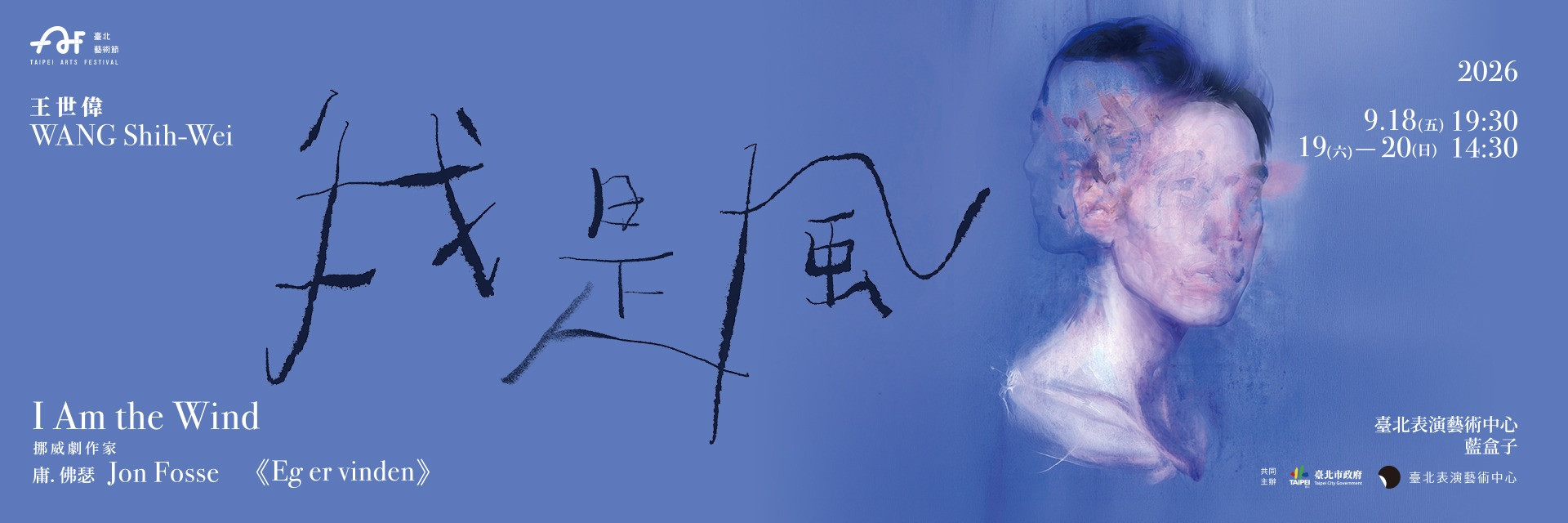
It was a misty dawn before the fog had cleared, or perhaps the dusk just before eternal night. Two drifting souls seek to understand each other through conversation, yet their intersecting words plunge into the bottomless ocean of life.
I Am the Wind has no thrilling, climactic plot; the characters' dialogue even feels detached and restrained. Yet, it directly confronts the meaning of existence: what could be more daunting than the challenges life itself brings? Written by Norwegian author Jon Fosse, hailed as "the Beckett of the 21st century" and the 2023 Nobel Laureate in Literature, I Am the Wind focuses on the things inexpressible, opening the audience's senses to experience the ineffable.
Writing the Unspeakable
Fosse has always believed that language fails in certain extreme situations, and that “only silence can convey the trembling of the soul." After completing I Am the Wind (Eg er vinden) in 2007, he took a 15-year hiatus from playwriting due to the physical and mental exhaustion and alcohol dependence caused by long-term creative work, before eventually returning to the theater with an even more refined, poetic language.
Structurally, I Am the Wind virtually abandons the frameworks of traditional theater: there is no backstory, no clear conflict or motivation, not even social attributes for the characters. For Fosse, the musicality of words, the power of silence, and the weight of pauses are far more important than actual plot or character development. His work depicts waiting as an agony that leads toward resolving the conflict between reality and desire. In this boundless expanse of nearly nothingness, "pauses" and "silence" become immense. Fosse wants people to hear this soundlessness and witness this negative space. Within this ecstatic,nyn or perhaps terrifying "blankness," he repeatedly probes the boundaries between life and death, loneliness and divinity.
Taiwanese audiences have long crossed paths with Fosse, who insists on writing in "Nynorsk" (New Norwegian). This choice, not merely an insistence on creating in his mother tongue, is an action born of political and aesthetic beliefs. Nynorsk breaks away from the cultural influence of neighboring powers, reclaiming forgotten local dialects and preserving the raw, vital musical rhythm of the region.
Plot advancement and dramatic conflict are not the core concerns of Fosse's creations. He believes that only through minimalist, highly restrained language can our deepest, unspeakable feelings truly be released. Through pauses, silences, the repetition of phrases, and rhythmic cycles, he constructs a sensory experience akin to music or religious rapture, leading the audience into a deafening tranquility and a cryptic realm of poetic aesthetics.
Tearing Down the Theater Walls
"The text is a map, but if you spend the whole journey staring at the map, you will miss the scenery."
Director WANG Shih-Wei subscribes to the creative philosophy of "putting down the map," which highly aligns with Fosse's desire to break free from the constraints of semantics and pursue the "absolute sensory experience."
Today, humans collectively face an era where words proliferate yet gradually lose their efficacy. Within the overwhelming weight of silence, a profound truth emerges: we can no longer escape the urgent necessity of facing our own existence. It is precisely at this moment, nearly two decades after its premiere, that I Am the Wind retains its enduring value. Collaborating across disciplines, Wang thus reframes theater from mere storytelling into an immersive sensory experience of time and bodily perception.
For him, spatial reconstruction is key. Breaking away from the traditional proscenium stage, which allows the audience to hide in the dark and watch from the sidelines, Wang transforms the TPAC’s Blue Box into an "Ocean Theater." Audiences scatter across different sections of the venue, becoming one with the multitudes drifting in the vast ocean of life.
The visual design of I Am the Wind leverages cross-disciplinary collaboration to create an unprecedented immersive experience. Within this space, lighting designer I-hua Kao reveals human radiance emerging from fateful darkness, while clothing brand PROJECTbyH. uses tactile fabrics to ground the lightness and weight of existence. Simultaneously, sound artist Yu-de Lin cuts through urban clamor to uncover a profound silence, as choreographer Tien Hsiao-tzu Tien uses deliberate movement to underscore the raw presence of the flesh.
Within the context of Taiwan's contemporary experimental theater, Wang repeatedly ponders the nature of "viewing" in the theater: "With the audience and performer in proximity, you must define your own perspective. You are no longer an audience in the traditional sense, but an active participant immersed within. Simultaneously, the challenge I want to undertake is creating a space of unawkward blankness; one that fosters equality, presence, and immediate on-site connection."
The Actors: Morning Mo and Zi-heng Lin
Who can soar freely upon the wind without being swallowed by the ocean? Performing I Am the Wind requires accepting life's imperfections and embracing the boundless power of human truth, as Wang put: "The joint participation of Mo and Lin carries a strong sense of contemporaneity. During the contemplative period of Taiwan's theater in the post-pandemic era, the collaboration between these two leading mid-generation actors symbolizes a renewed pursuit of 'artistic depth' by Taiwanese theater practitioners. No longer satisfied with glamorous packaging or issue-driven debates, they choose to enter a desolate existential predicament alongside Fosse, seeking peace within the play."
In Wang's eyes, Mo and Lin possess an intense energy of faith. While Mo exudes a texture that is "introverted, fluid, and fragmented," excelling at handling the repressed emotions lingering at the boundaries of the soul, Lin, on the other hand, represents the power of precision, intellect, and stability. Mirroring each other, they abandon acting to simply 'be.' Their breathing and emotional exchange construct a volatile yet profoundly real landscape of life within the space.
Let the Wind Caress
In an information-saturated society, we rarely quiet down to confront our solitude; instead, we weaponize words and images to resist existential loneliness. Fosse, however, pulls us into the core of seclusion to carve out a space within a clamorous, fragmented world; a sanctuary where the soul can rest and commune with nature and the divine.
As we drift across the vast ocean of life, hovering near the inescapable darkness of human existence, the presence and breath of others seep into our awareness. In this space of refuge created by I Am the Wind, we can all learn to listen—to the rhythms of life beyond language, to each other's existence, and to the soothing wind of the soul.
If we can realize, even for a moment, that the immense silence is nothing to fear, we might just reclaim the profound echoes buried deep within our own souls.
Director|Wang Shih-Wei
Associate Director|Tien Hsiao-Tzu
Performers|Mo Tzu-Yi, Lin Zi-Heng
Lighting Designer|I-Hua Kao
Sound Designer|Lin Yu-De
Acoustic Designer|Chen Yu-Chien
Set Designer|Chen Guan-Lin
Costume Designer|PROJECTbyH.
Stage Manager|Teng Hsiang-Ting
Technical Director|Liu Bo-Yan
Master Electrician|Ting Hao-Tsu
Video Documentation|Chan Ki-Yan
Photography|Dabei Chin
Assistant Director|Peng Hao-Chin
Production Coordination|PROJECT ZERO Performing Arts Managemen
Ticket Benefits
Know more about TPAC member: https://tpacplayer.org/q3t4z
2026.6.15 (Mon.) 12:00 ── 6.22 (Mon.) 11:59 Paid Member Pre-sale
Paid Member Offers:
TPAC member - Addict Player: 25% off; get one 50% off voucher when purchasing 3 shows
TPAC member - Trooper Player: Single ticket 15% off, 4 or more tickets 20% off, 10 or more tickets 25% off
2026.6.22 (Mon.) 12:00 Official On-sale
Member Offers:
TPAC Member - Addict Player: 15% off; get one 50% off voucher when purchasing 3 shows
TPAC Member - Trooper Player: Single ticket 15% off, 4 or more tickets 25% off, 10 or more tickets 30% off
TPAC Member -Rookie Player: 10% off; free registration to enjoy ticket discounts
Returning Customer Offer:
2026.6.22 (Mon.) 12:00 ── 7.26 (Sun.) 23:59
Customers who purchased 2025 Taipei Arts Festival programs and hold Rookie Player status before 2026.6.15 (Mon.) 12:00 will receive two exclusive 15% off vouchers on 2026.6.15 (Mon.). ※Valid until 2026.7.26 (Sun.).
Rookie Player Package Offer:
2026.6.22 (Mon.) 12:00 ── 7.26 (Sun.) 23:59
Purchase tickets worth NT$1000 or more: 2 tickets enjoy 12% off, 3 tickets or more enjoy 15% off.
TPAC Member Exclusive Package Offer:
TPAC members who have completed OPENTIX account linking are eligible for a Member-Exclusive 1+1 Package Offer.
From 2026.6.15 (Mon.) 12:00
Addict Player / Trooper Player: 25% off Taipei Arts Festival programs + TPAC Member-exclusive special price of NT$199 for the “Invisible Connections of the Body” performance workshop.
From 2026.6.22 (Mon.) 12:00
Rookie Player: 10% off Taipei Arts Festival programs + TPAC Member-exclusive special price of NT$299 for the “Invisible Connections of the Body” performance workshop.
Partner Discounts
From 2026.6.22 (Mon.) 12:00
Members of Eslite, cardholders of E. Sun Bank, Taipei Fubon Bank, and Taishin Bank: 8% off ticket purchase.
Group Ticket Discounts
20 or more tickets in a single order: 20% off.
50 or more tickets in a single order: 25% off.
100 or more tickets in a single order: 30% off.
Other Discounts:
Disabled individuals and their necessary companions (limited to 1 person) enjoy 50% off (please present disability certificate at entry).
Senior citizens aged 65 and above enjoy 50% off (please present valid identification at entry).
※ The presenter reserves the right to make program changes and to interpret all discount terms and conditions.
Organizer