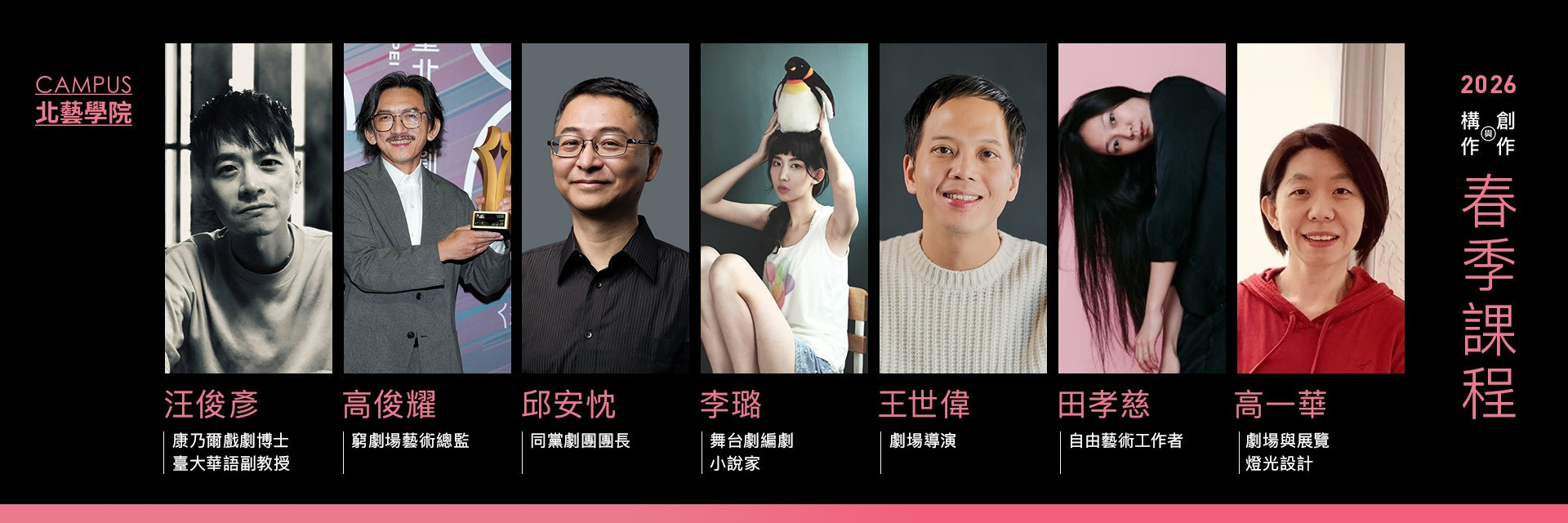
At the core of the spring curriculum is the script, in addition to explorations of multiple aspects of theatrical creation. It includes nine lectures and three playwriting workshops.
Series 1: What Is Modernity? – From Translation to Transnational Criticism
Dramaturgy often begins with the script. But, how does a script take shape? What is its connection to modernity in theater? Modern drama remains the mainstream narrative method in contemporary theater today. In this lecture series, how acting methods, physicality, language, space, and audiences constitute modern drama are analyzed. Then, "worlding" is explored from the perspectives of cultural materialism and cultural translation, in addition to how modernism became modern. Moreover, by critiquing modernity, renewed thinking has emerged regarding transnational and translingual practices in dramaturgy and criticism.
Lecture 1 (3.3.2026): Where did modern drama come from? The birth of physicality, language, and the black box
When audiences step into a black box, it as if they are entering a spatial imagination of “the modern.”
How did modern drama come about? And how does it respond to modern people’s perceptions, physical experiences, and viewing methods?
Starting with the emergence of realism and extending to the formation of body and language as the core on stage media, modern drama is viewed not merely as a shift in aesthetic style, but also as a method of understanding the world and people. From the perspective of cultural materialism, the historical context of modern drama is re-examined to understand how the black box has become a universal archetype for theaters worldwide and how modern drama has shaped the relationships between audiences and performers.
Lecture 2 (3.17.2026): Modernism and cultural translation
Modernism is often considered an art movement that originated in Europe. However, we can think about this in another way: Was modernism “discovered” in Europe or has Europe been construed as the center of modernism through translation?
Through translation, the styles and methods of modern drama have gradually formed, shaping what in the theatrical world is known as “modern” within the transcultural movement. Compared with past aesthetic discussions that mainly focused on original creations and transplants, participants gain a renewed understanding of how modernism has been studied, transformed, and regenerated in multiple contexts, starting from the perspective of cultural translation.
Lecture 3 (3.31.2026): Drama, translation, and translingual imagination
When theatrical works cross languages and national borders, the stage is no longer a representation of one culture. Rather, it is a domain co-generated through translation, dramaturgy, and viewing.
In this lecture, theatrical works are analyzed to re-examine how translation mechanisms influence creation and criticism and to think about how dramaturgy and criticism form new viewing perspectives in transnational and translingual contexts. Transnational theater is not just concerned with geography, but also with practices that involve continuous negotiation, interpretation, and redefinition.
Series 2: Literary Narrative, Cross-boundary Flow - Talking About Script Structure
A script is not an isolated entity. Rather, it is deeply connected to the creator’s language, upbringing, and cultural experience. Based on his transcultural experience, KOH Choon-Eiow shares how different cultural elements ferment during the creative process. In addition, he focuses on how scripts materialize while switching among his three roles: playwriting, directing, and performing, and how the final version is set in the rehearsal room.
Lecture 1 (4.14.2026): Return - origins of identity, culture, and writing
How can a script convey identity, memory, and cultural experience?
As narratives move across languages, ethnicities, and media, how does the stage become a place for positioning oneself and others?
Starting from personal experience and creative practices, how literary narrative is transformed into stage action is explored. Multiple possibilities for structuring a script are analyzed based on the dichotomies of reality and fiction and writing and viewing.
Lecture 2 (4.21.2026): Departure – the script takes to the stage
When a story moves from words to the stage, the narrative shifts.
Wandering between reality and fiction, choosing between dialogue and silence…how is the transition made from script to stage directions during the rehearsal process?
Based on the creative experience of a playwright, director, and actor, narrative transitions are deconstructed based on different media. In addition, the stage’s role in shaping the viewing relationship and the ever-shifting aesthetic boundaries between audiences and performers are examined.
Series 3: From Individual to Co-creation – Scriptwriting Methods
Armed with source materials, how do playwrights determine the relationships among themes, stories, and forms? What is the difference between solo playwriting and collaborative playwriting? What are the advantages of writing alone and collaborative writing? What are the disadvantages? Playwright CHIU An-Chen, who wrote the script for Father Mother, which won the Best Play Award at the first Taipei Theatre Awards, shares his creative insights including his experience working with different themes and collaborative partners.
Lecture 1 (4.16.2026): Writing alone: Creative processes for Father Mother and The Mandarin Class
CHIU An-Chen shares his three-year writing, research, and development process for Father Mother. During rehearsals how did CHIU, who is both a playwright and an actor, make changes to the script in collaboration with the other actors and the director? In addition, during the creation of The Mandarin Class, how did he, in his role as playwright, work with collaborative partners to develop the script?
Lecturer: CHIU An-Chen
Lecture 2 (4.30.2026): Writing with a partner: Co-creating Cinderfella with LI Lu
Cinderfella is a one-man show inspired by the life of Feng Feng, a victim of the White Terror (a period of post-war political oppression in Taiwan). Why was this topic used to create a one-man show? And why was it decided that one actor should play multiple roles in the telling of this story? How did CHIU An-Chen and LI Lu, playwrights from different generations, inspire one another and achieve their writing goals together?
Lecturers: CHIU An-Chen, LI Lu
Series 4: Heartbreak Playwriting Course
Creation is a test of skill in confessing to an audience. After a sincere confession, you may hear statements of praise such as, “You worked hard,” “Keep it up,” and “It’s a great achievement just to have finished.” Your heart sinks and sinks, then sinks further. In the days that follow, words linger as do a lump in your throat and a sense of melancholy and sadness. Are these signs of unfulfilled talent or a lack of experience? From your heart (sorry, not the center of the world), you cry out, “What is it about me that is not good enough?!” This workshop begins with a discussion of the frustrations of writing and explores how to engage in a passionate love affair with the art of writing, which begins with perseverance. Ah, no. It’s time to face heartbreak head-on with an open mind.
Lecture 1 (4.14.2026): Return - origins of identity, culture, and writing
How can a script convey identity, memory, and cultural experience?
As narratives move across languages, ethnicities, and media, how does the stage become a place for positioning oneself and others?
Starting from personal experience and creative practices, how literary narrative is transformed into stage action is explored. Multiple possibilities for structuring a script are analyzed based on the dichotomies of reality and fiction and writing and viewing.
Lecture 2 (4.21.2026): Departure – the script takes to the stage
When a story moves from words to the stage, the narrative shifts.
Wandering between reality and fiction, choosing between dialogue and silence…how is the transition made from script to stage directions during the rehearsal process?
Based on the creative experience of a playwright, director, and actor, narrative transitions are deconstructed based on different media. In addition, the stage’s role in shaping the viewing relationship and the ever-shifting aesthetic boundaries between audiences and performers are examined.
Three workshops: 5.4 - 5.6, 2026
Series 5: Between Light and Body: The Making of Theatrical Perception
Surging of waves and light shining through the clouds–in 19th century landscape paintings colors were used to capture the grandeur of nature, while in the theater light and shadow, the body, and space are used to enable audiences to perceive the pulse of life. Director WANG Shih-Wei, together with lighting designer KAO I-Hua and choreographer TIEN Hsiao-Tzu, engage in dialogue and guide participants in gaining an understanding of how words, movements, and light and shadow interact in the theater to shape unique sensory experiences.
Lecture 1 (5.7.2026): Sentences of the Body: Between Language and Movement
How can the poetics of language be transformed into the movement of the body? How do pauses, repetitions, and ruptures in words become motion and emotional flow on stage?
This talk brings together director Wang Shih-Wei and choreographer Tien Hsiao-Tzu in a conversation inspired by Jon Fosse’s I Am the Wind. They will explore how rhythm and silence in language can awaken bodily imagination, and how “presence” can be perceived and felt within theatrical space. The discussion will extend to Tien’s creative practice, including her choreographic works and cross-disciplinary collaborations, to examine how movement shapes character, generates emotion, and reveals the unique sense of presence on stage. Finally, the speakers will invite the audience to participate physically through simple movement exercises—momentarily setting aside rational thought to experience the instant when language becomes motion and rediscovering the power of perception between word and body.
Lecturers: WANG Shih-Wei, TIEN Hsiao-Tzu
Lecture 2 (5.12.2026): Light Beyond the Canvas: Between the Sublime and Solitude
This talk brings together director Wang Shih-Wei and lighting artist Kao I-Hua in a conversation that begins with the aesthetic of the sublime and journeys into the seascapes of nineteenth-century European painting. Between light and mist, motion, and stillness, we will explore how artists depict the tension and silence between humanity and nature. Extending into the theatre, the speakers will share how lighting design can evoke the bewilderment and solitude of confronting the vastness of life. Centering on Jon Fosse’s I Am the Wind, the discussion traces how painting inspires contemporary theatre’s spatial composition and poetics of light. Join us to witness, between light and darkness, the depth and glimmer of life itself.
Lecturers: WANG Shih-Wei, KAO I-Hua
Organizer