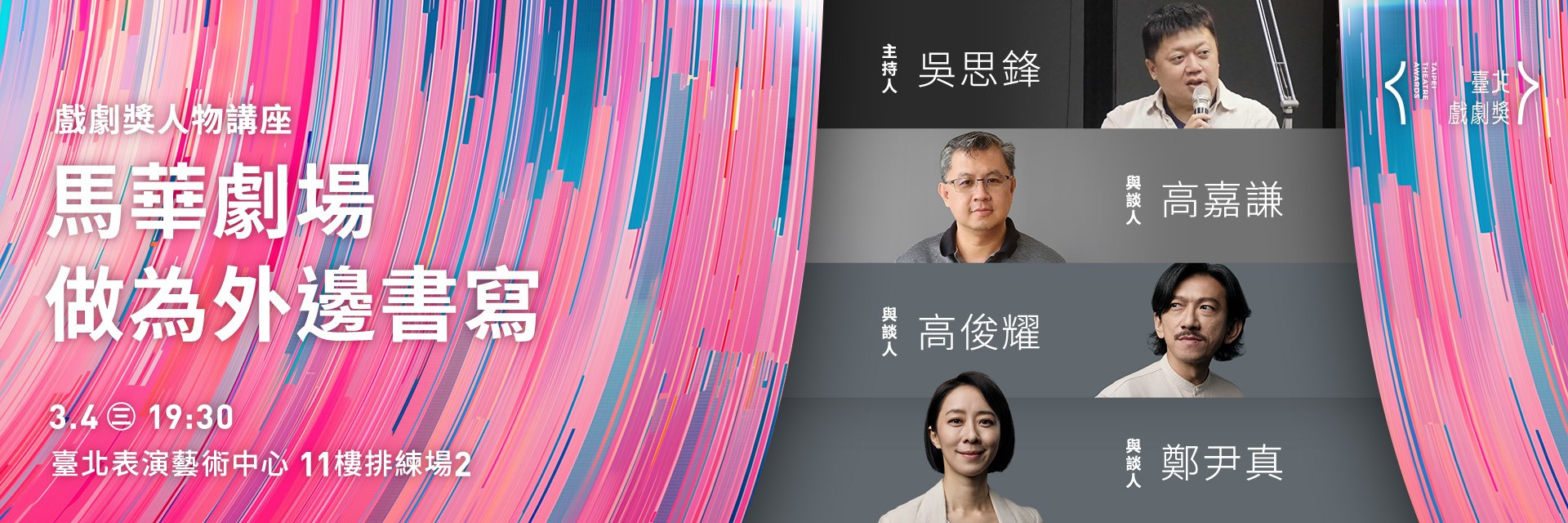
The Legend of the White Snake and Hezhu’s New Match occupy important places among Taiwan’s theater classics. However, approaching theatre uses its own way of dealing with official histories, choosing the less popular Zhu Bian. The parallel universes of Taiwan and Malaysia have inspired Koh Choon Eiow and, in recent years, he has diligently explored the classical and modern arts.
The question is, if we don’t write history in such a self-evident and one-sided way, then where exactly should we write about Koh Choon Eiow and other representatives of Malaysian Chinese theater? Just like an exorcist can prove that a female ghost is a historical figure, this night we become captivated by Taiwanese theater, as ghosts and entities flow back from the margins.
Moderator | Wu Sih-Fong
Wu Sih-Fong is a little theater worker and art critic, based in Hualien. He is primarily involved in theater through writing, editing, planning, and production. His focuses are on little theater practices, as well as the rereading of their genealogies, non-metropolitan area theater creation and operations, theater ecology and institutionalization, criticism, and media.
His other credits include editor-in-chief of a book series for Zebra Crossing Publishing and co-curator of the Taoyuan Iron Rose Festival (2024-2026). In Hualien he has created a space especially for exhibitions and reading related to little theater.
Panelist |Ko Chia-Cian
Ko Chia-Cian is a professor and vice chair of the Department of Chinese Literature at National Taiwan University, as well as author of Maritime Poetry Road: East Asian Routes and Nanyang Mesology (2024); Malaysian Chinese Literary Criticism: Ko Chia Cian (2019); and Loyalists, Boundary and Modernity: Southbound Diaspora and Lyricism of Classical-style Chinese Poetry (1895-1945) (2016). He also served as editor-in-chief for Sinophone/Xenophone: Contemporary Sinophone Literature Reader (with David Der-Wei Wang and Woo Kam Loon); A Nanyang Reader (2022); and Sinophone Malaysian Literature: A History through Literary and Cultural Texts (with Tee Kim Tong and Ng Kim Chew) (2022).
Panelist|Koh Choon Eiow
Koh Choon-Eiow is Malaysian Chinese and co-artistic director of approaching theatre. He is also a contemporary theater director, playwright, and actor, as well as an Asian Cultural Council award recipient. A graduate of the Drama Department of the Malaysian Institute of Art and the College of Arts of Chinese Culture University, his works are characterized by powerful narratives and precise timing. Koh is adept at using polyphonic contexts and flowing narratives to explore the subjective construction of capitalist societies and the scattering and identity of ethnic Chinese people throughout colonial history. His works and awards include: Apostating Time, recipient of the 22nd Taishin Annual Grand Prize and the Jury Award at the 35th Golden Melody Awards for Traditional Arts and Music; Chronology on Death and A Gambling World II, performed during the Annual Program of Guling Street Avant-garde Theatre; Anger, recognized with the first Taipei Fringe Festival “star of tomorrow” award; and Ghostopia for which he received the Taipei Theatre Award for Best Play Writing.
In 2025, he received a theater development grant from the Taipei Performing Arts Center.
Panelist|Cheng Yin-Chen
Cheng Yin-Chen is co-artistic director of approaching theatre. Her long-time focus has been on the historical context and political situations reflected through listening and aesthetic appreciation. She is the creator of The Sewing of Time and Wang Shen Zhi (Forget Yourself), and initiator of Lian Ai Sheng Yin Xue (Soundology of Love). She currently teaches a course on special topics in sound in the Department of Theatre Arts at Taipei National University of the Arts. In 2016, she received a grant from the Asian Cultural Council to study traditional music and dance in Central Java, Indonesia and Seoul, South Korea. Her recent performances include A Mother, King Lear, shortlisted for the Taishin Arts Award; Apostating Time, recognized with the Taishin Annual Grand Prize and the Jury Award at the Golden Melody Awards for Traditional Arts and Music; and Ghostopia, for which she received the Taipei Theatre Award for Best Actress in a Play.
In 2025, she received a theater development grant from the Taipei Performing Arts Center.
