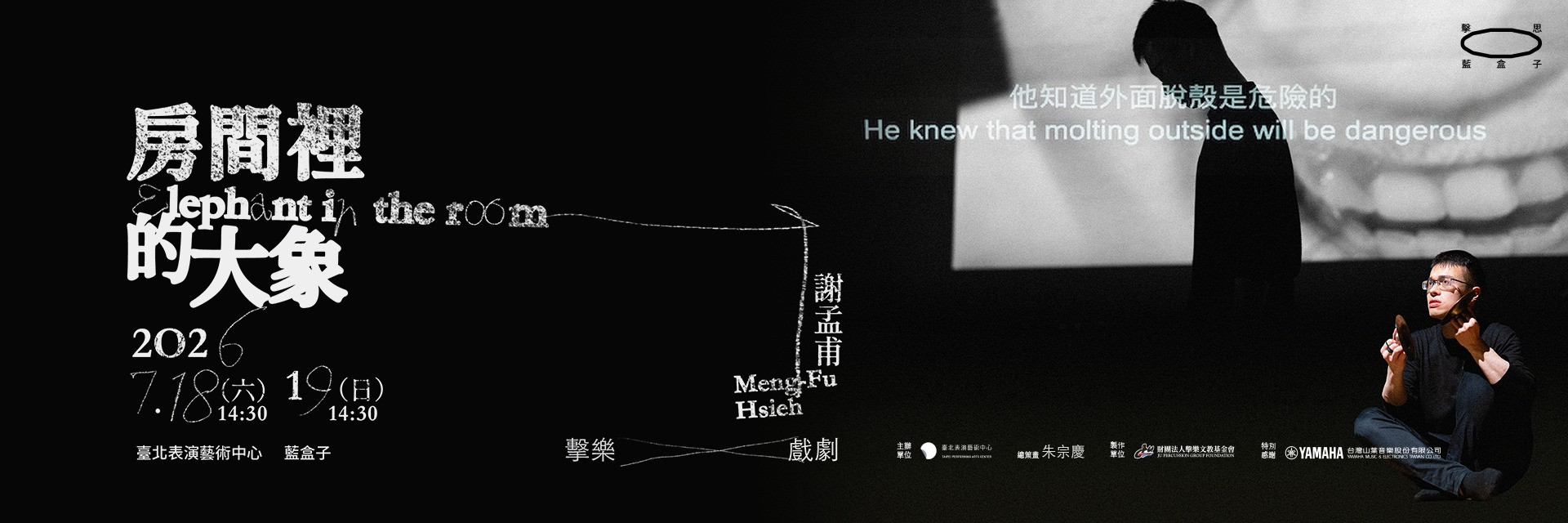
When silence becomes the norm, dare you speak what you see?
When conformity is systematic, what remains of the true-self?
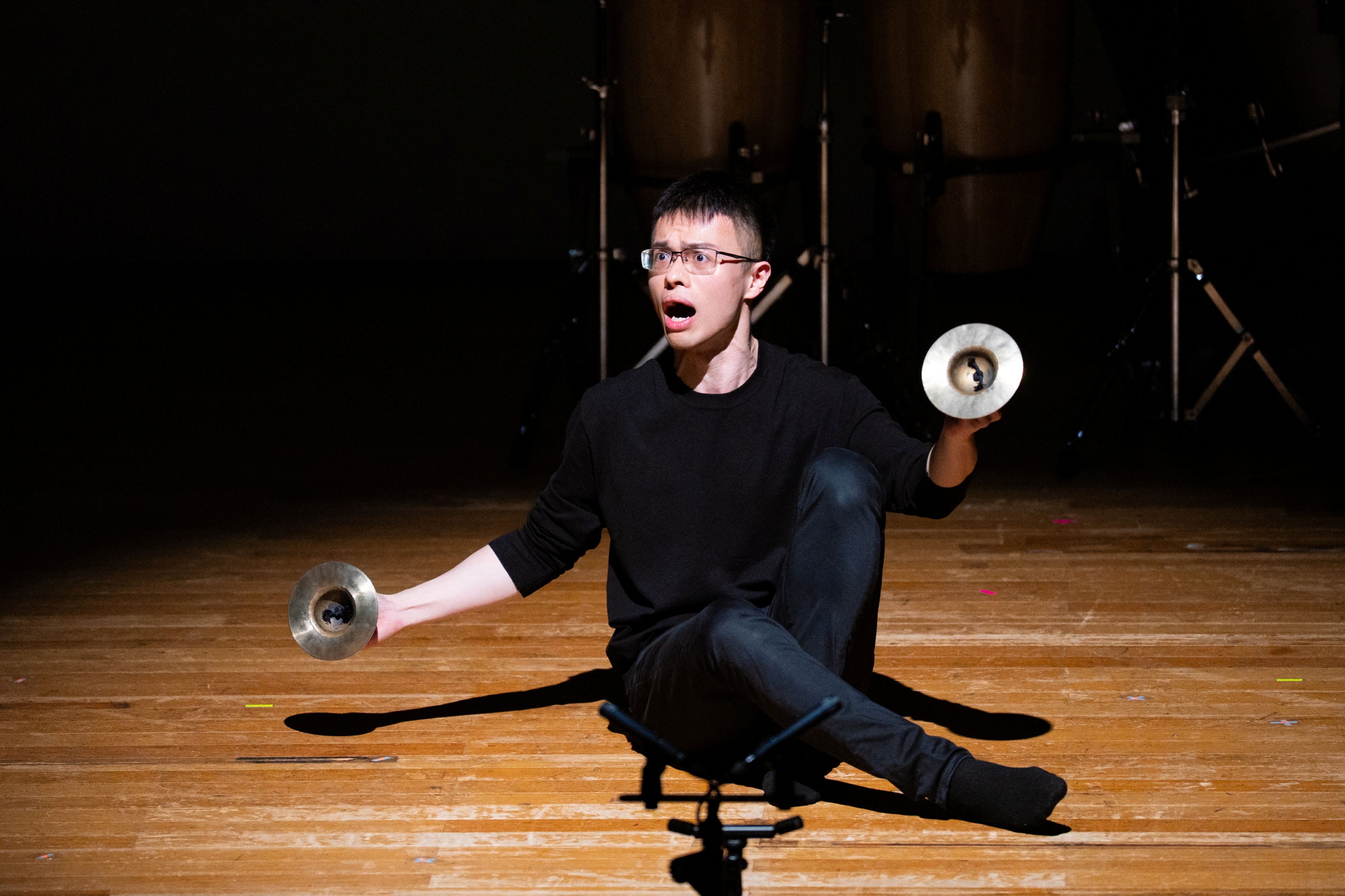
Percussionist Meng-Fu Hsieh strikes out the most harrowing cry in Diary of a Madman.
A cornerstone of modern Chinese literature, Lu Xun’s Diary of a Madman depicts stories told through the eyes of a lunatic. The narrator perceives a terrifying truth: the omnipresent rhetoric of Chinese morality—benevolence, righteousness, propriety—is nothing more than a veil for a cannibalistic social order. Yet precisely because he called out the “Elephant in the Room,” he is dismissed as insane. The multimedia music-theater work Elephant in the Room extends this act of defiance. Percussionist Meng-Fu Hsieh merges percussion, electronic music, theatre, and video into a multimedia music-theater work. Neither concert nor play, the piece interrogates the tension between individual freedom and collective constraint, both formally and conceptually.
Drawing on experiences we all recognize yet rarely articulate, Elephant in the Room invites audiences into a theater of auditory lucidity, madness, and collective violence.
In the story, the “madman” becomes increasingly convinced that he is being surveilled and persecuted by family, neighbors, and society at large. He comes to believe he lives within a “man-eating” world, where morality serves as a mechanism of sacrifice and subordinating the individual to the collective. He asks, again and again: “If it has always been so, does that make it right?” As fear deepens, even those closest to him become suspicious. In the end, he cries out: “Save the children,” a fragile hope that the future may escape this seemingly-peaceful disorder.
Sound constructs atmosphere. Sound sketches space. Sound propels action. The clatter of mahjong tiles, the act of chewing, the friction and collision of objects—these everyday noises are transformed into theatrical language, creating an anxious, surreal rhythm.
In its most unsettling passage, “Cannibalism!,” performers and electronic sound move through a multi-channel spatial design that surrounds the audience. No longer mere observers, the audience is enveloped—implicated within the very structure of this “man-eating society.” The sounds that emerge are at once markers of fate, of time passing, and of madness intensifying.
With no complicated stage design, light and shadow draw distinct boundaries between the interior and exterior, reality and dream.
The show’s costume and stage design draw heavily on calligraphic elements, translating the lines of tradition into visual pressure. Facial markings borrow from the symbolic codes of Peking opera, reinterpreted through stark, contemporary color fields, producing an uncanny fusion of the archaic and the futuristic. Visually, light and shadow carve up interior and exterior, reality and dream, creating boundaries that remain in constant flux.
The “elephant in the room” does not sit still on the stage. It walks into your reality.
Propelled by music, where sound itself becomes narrative, the work exists outside a fixed timeframe. It may unfold in a diary from 1918, in a contemporary multimedia theater, or within the cubicle confines of work and into your social network.
As you are drawn in deeper, you may feel unsettled, challenged, or even provoked. You may disagree, but you may not disregard its existence. Elephant in the Room is not disposable entertainment, but an exploration of perception, consciousness, and one’s position within the world. Because this work offers not just something to watch, but something to experience, we are compelled—perhaps more than ever—to ask: Do we still possess the ability to recognize the truth—and to speak it?
Meng-Fu Hsieh
Adapted Script, Lead Music-Theatre Creator & Performer
Born in Taiwan in 1995, Meng-Fu Hsieh is an internationally active percussion soloist and music-theatre creator, and a Yamaha Europe Artist. His artistic practice bridges contemporary percussion, electronic music, and interdisciplinary theatre, focusing on sound as a narrative medium and the performer’s body as a dramaturgical presence. Trained at the Conservatoire National Supérieur de Musique et de Danse de Lyon and the University of Music and Performing Arts Stuttgart, he studied with Jean Geoffroy and Marta Klimasara.. etc, and in 2025 graduated from the Konzertexamen program with highest distinction. His performance career has taken him to major international platforms including TROMP Percussion International Competition (Laureates’ Recital Series), PASIC, the Keiko Abe International Music Festival, the Moscow Forum for Contemporary Music, and the World Marimba Competition.
Organizer

Co-Producer