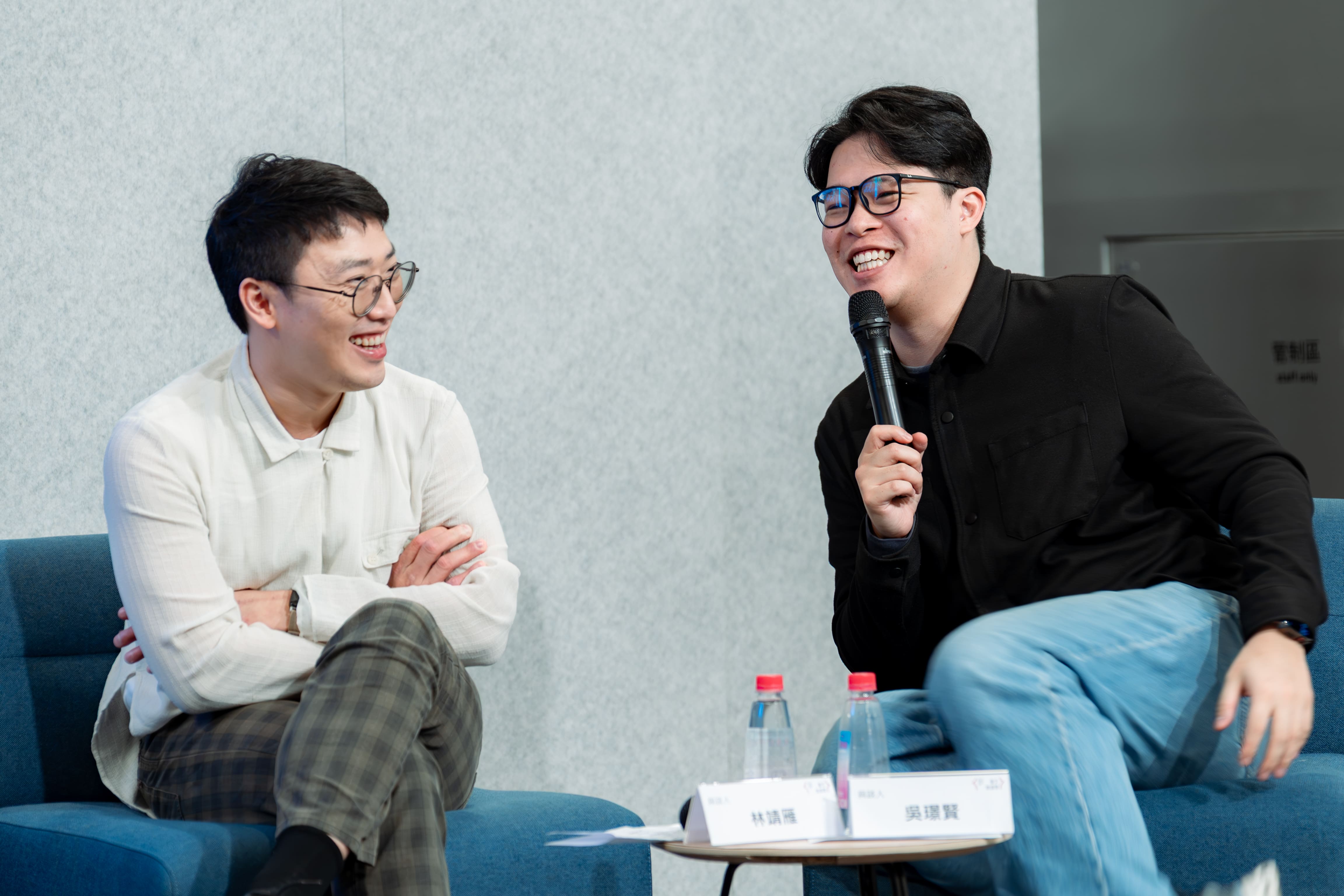
Nothing Small on Stage: Survival Notes from the Fringe Festival to the Theatre Awards
Taipei Theatre Awards
Below is a faithful, publication-ready English translation. The tone is analytical and descriptive, preserving the pacing and reflective quality of the original text while remaining clear and readable for an international arts context.
At the beginning of the lecture, host Wang Chun-yen did not immediately move into an analysis of the works. Instead, he first clarified the background and context of the discussion. With the inaugural Taipei Theatre Awards having just concluded, two works with markedly different creative approaches—one a musical, the other a highly personal independent production—had simultaneously entered the awards landscape. This convergence became the starting point for the lecture. The two creators were then invited to return to a fundamental question: How did each of you begin your journey into theatre-making?
If you want to enter theatre, start by being an audience member
Lin Jing-yan opened by returning directly to his own starting point. “I dropped out of school at sixteen. At that time, I honestly had no idea what I was going to do.” He recalled that he was living in Chiayi then, and through a series of coincidences entered a local theatre troupe, almost as if he had been “taken in as a matter of course.” It was there that he first realized that theatre was not merely a hobby or an activity, but a form of creation actively being practiced. “That was the first time I started to think—these people are really making work, really doing theatre. Could this possibly be a profession?”
His path into theatre did not begin with systematic training, but with repeated exposure to performances. Watching shows in large numbers, staying afterward to chat, or simply lingering in the same space became his earliest way of understanding theatre. “Later, I became very certain about one thing,” he said. “If you want to enter theatre, start by being an audience member.” For him, this role was not merely a point of entry, but a sustained state of being present.
What truly motivated him to come to Taipei was neither a call from academia nor a clear plan for further education, but an impulse to get closer to the site of creation. “At the time, I just thought—I have to go up there and see for myself, see what the art schools are actually doing.” Yet once he arrived, he quickly discovered that institutions operate according to their own established systems. “Theatre academies have their own rules,” he said.
Positioned outside the system, he encountered a series of very concrete limitations: auditing classes was difficult, entering rehearsal rooms was nearly impossible, and many learning pathways were simply closed to those outside the institutional framework. “That’s why I later felt very fortunate to enter a place called Little Theatre School,” he added. “It was there that I began to understand how one might create without attending TNUA.”
I have something I want to say, and I want the audience to understand it
When discussing his first creative work, Lin described his motivation in very direct terms: “My motivation was actually very simple. I had something I wanted to say, and I wanted the audience to understand what I was saying.”
At the time, he was dealing with a physical and psychological condition that required repeated explanation to others. Rather than continually explaining himself, he chose to respond through a work. “Instead of constantly talking about it, I figured I might as well make a piece and let people see it.”
His first work had only one performer—himself. He used his own body as the sole material, inviting different directors to work with the same body and develop independent segments. “At the time, I really didn’t think that much about it,” he recalled. “I just felt that maybe this way I could say everything I needed to say.”
In recounting this experience, he did not retrospectively evaluate whether the work was “successful,” nor did he assign it additional meaning after the fact. Instead, he simply narrated how things unfolded: how he contacted directors, how he explained his ideas, how they responded—some willing to try, others unable to understand.
“Damo told me from the beginning that he couldn’t understand what I was writing.” The line drew brief laughter from the audience, but Lin immediately added, “Later, someone helped explain it to him, and then he started thinking about what this young person was actually trying to do.”
For him, being misunderstood was not an obstacle to overcome, but a real process of communication. A work does not come into being because it is understood; it takes shape gradually through repeated explanation, revision, and waiting. It was through these practical experiences that he began to realize he might move toward a mode of creation that combined writing, directing, and performing. “Not because I wanted to do everything myself,” he said, “but because, at that moment, that was what I was capable of doing.”
Some things will not happen unless you do them yourself
Before his personal creative language fully took shape, Lin spent a great deal of time returning to the site itself. He did not describe Guling Street Avant-Garde Theatre as a symbolic landmark, but very practically, as “a place where you could stay for long periods of time.” The lobby on the first floor, the black box on the second, the smoking area—these spaces were not designed for learning, yet through repeated presence, they became places where exchange naturally occurred.
Often, it was not formal rehearsals or discussions, but simply “hanging out and chatting when there was nothing going on.” Theatre talk blended with conversations about things beyond theatre. These exchanges did not immediately turn into works, but resurfaced later as contextual knowledge that shaped his understanding of creation.
“During that time, I watched a lot of theatre,” he said. “I was basically always watching shows at Guling Street.” For him, watching was not about accumulating a list of works, but about observing how different creators worked—how they used their bodies, how they handled the stage, how they spoke to audiences. These differences were not systematized into a method, but slowly accumulated through experience.
It was in this state that he began making small-scale works closely aligned with his own conditions. Limited personnel, insufficient technical support, simple venues—many things could only be done on a “do-what-you-can” basis. Rather than concealing these limitations, he assumed them from the outset: these were the conditions, and the work had to be completed within them.
When he spoke about gradually adopting a mode of “one person completing an entire production,” his tone remained matter-of-fact. “It’s not that I’m better than others,” he said. “You just slowly realize that some things won’t happen unless you do them yourself.” From writing and rehearsing to load-in, performance, and strike, the body was forced to take on more and more functions—not by choice, but as a response to reality.
This mode of working extended into a series of performances before he participated in the Fringe Festival. Most of these works were not created within festival frameworks, but through independently finding spaces, finding time, and deciding, “We’ll perform at this moment.” Some shows had few audience members; some were attended only by friends. Yet he did not categorize these experiences as “early stages” or “trial runs,” but simply as performances that had actually taken place.
Creation must begin immediately within known conditions
When the conversation turned to the Fringe Festival, Lin did not start with institutional discussion, but with his immediate impressions. Load-in, performance, and strike were compressed into extremely short timeframes. Many details that could normally be adjusted repeatedly had to be decided quickly. “You become very clear about what can’t be done this time,” he said, “and then you can only figure things out within what remains.”
He did not frame this experience as training or methodology, but as a concrete working condition: accelerated rhythm, reduced options, and creation that must begin immediately within known constraints. Work does not wait until preparation is complete; it is forced to respond once conditions are clearly defined.
Theatre is not just a site of performance, but a way of intervening in reality
Following Lin, the discussion shifted to another path into theatre. Wu Jing-xian began his self-introduction almost with a single sentence: “I wanted to be an actor from a very young age.” He quickly added that it was not a straight path.
He traced his upbringing in Macau. After joining a drama club in elementary school, he entered the Macau Conservatory of Performing Arts during secondary school, where he studied for six years. It was not a degree-granting institution, but a training system established by the Cultural Affairs Bureau, oriented toward after-school and interest-based learning. Students came from various age groups and did not necessarily aim to become professional actors, but the long-term and intensive training made theatre a constant presence in daily life.
“At the beginning, it was really just a simple desire to act,” he said. The turning point came when teachers began asking students to create, rather than merely interpret texts. “They would ask us, ‘What are you concerned about right now?’”
While still in junior high, students were required to understand ongoing social events and reflect on their relationship to them. He recalled that Macau was then facing controversy over the proposed legislation of Article 23 of the Basic Law. Teachers did not impose positions, but asked students to investigate and respond on their own. “We really started looking at what society was doing, and using theatre to deal with these issues.” It was through this process that he first realized theatre was not merely a place for performance, but a way of intervening in reality and responding to the world.
When conditions are limited, choices become more concrete
He later entered TNUA and came to Taipei. After graduation, he described a period of uncertainty: he still wanted to be an actor, but gradually realized that simply waiting for roles could not sustain his creative needs. “I became very clear that I didn’t just want to act—I also wanted to create.”
This realization did not come with a clear strategy, but took shape through repeated attempts. He shifted positions across different works—sometimes directing, sometimes writing, sometimes appearing both onstage and backstage. “There was a period when I honestly felt like I was going crazy,” he said, then returned immediately to the experience itself without elaboration.
Speaking about the Dormitory series, he noted that the initial conditions were far from ideal. Time and space were strictly constrained; load-in, performance, and strike had to be completed within extremely short periods, leaving almost no room for error. To achieve the sense of everyday life he sought onstage, the team paradoxically had to invest more labor early on, arranging details in advance.
“You know very clearly that you can’t just do whatever you want,” he said. Within the Fringe Festival framework, venues, schedules, and technical resources were predefined. The task was not to break rules, but to respond to conditions. He did not describe this experience as oppressive, nor frame it as training, but simply noted that when conditions are fixed, choices become concrete: what must remain, what can be discarded, and which details are worth preserving must all be decided within limited time.
When he later began working in larger venues, Wu admitted that he initially struggled to adapt. Moving from black box theatres to proscenium stages, changes in scale directly affected performance style and blocking logic. “You start to question whether what you were doing before is still the same thing when placed in such a large space.”
Creation does not begin because it is seen
For the most part, awards functioned merely as a node through which past experiences could be retold. The host remarked, “A lot of things were already happening before the awards.” Creation does not begin because it is seen; it continues even when it is not.
Lin explained that there was a period when he was unfamiliar with stage technology. Lighting, sound control, and stage management had to be learned on the job. “Often it’s not that you don’t want to find someone,” he said. “You simply can’t find anyone.” With limited budgets and small-scale productions, technicians could not commit long-term, and creators ultimately had to fill in these roles themselves.
He described the rhythm surrounding certain performances: load-in during the day, performance at night, strike the next morning, then a return to his regular job. Physical exhaustion was not emphasized, but naturally embedded in the narrative. “You learn how long you can hold out,” he said, “and then you plan according to that.”
This working condition gradually shaped his choices of form. Limited personnel and constrained space led him toward direct, face-to-face structures with audiences, minimizing complex staging and allowing the body to bear the primary weight. This was not a predetermined aesthetic stance, but a habit that emerged through repeated practice.
How do error and compression become part of performance?
Speaking again about the Fringe Festival, Lin recalled an error that occurred during the printing of promotional materials. The planned quantity was exceeded several times over, resulting in an unmanageable pile. “At the time, I really didn’t know what to do. Throwing them away didn’t feel right, keeping them was useless.” In the end, he spread the flyers across the stage floor, directly incorporating them into the performance. This solution was not a predesigned effect, but an immediate response to the situation at hand.
By contrast, Wu spoke of a different kind of adjustment. Under Fringe Festival regulations, teams must complete all processes within extremely short timeframes, challenging working methods that rely on meticulous rehearsal. “You know very clearly that some things can’t be done this time.” Rehearsal time was redistributed, stage elements simplified—but certain details he deemed essential were retained.
“It’s not because we wanted to prove anything,” he added. “It’s because if we removed even these, the piece would no longer be the one we wanted to make.” This judgment did not arise from abstract principles, but from what remained after continuous reduction under constraint.
Many things do not change just because you win an award
When the discussion turned directly to awards, the host avoided asking about “how it feels to win,” instead focusing on tangible changes brought by recognition. Both creators responded cautiously. Awards did increase visibility and made certain collaborations possible, but they did not alter the fundamental conditions of creation.
“Many things don’t change just because you win an award,” Lin said. “The next day, you still have to figure out how to make the next piece.” The statement was not extended into a critique of institutions or industry, but simply pointed to an ongoing working reality.
Wu noted that entering larger production systems required relearning how to collaborate across more departments. As resources increased, decision-making processes also became more complex. “You can’t just focus on what you yourself are thinking,” he said. “You have to understand how the entire production operates.” This shift was not framed as a sacrifice, but as a mode of work that one must adapt to.
As audience questions were addressed, the discussion returned once more to recurring details: how time is allocated, how the body is used, how space shapes choice. Creation was ultimately presented as a continuously adjusted working condition—the freedom of theatre emerges from limitation.