Behind the Curtain: The Hidden Forces of Performance
Taipei Theatre Awards
Here is a clear, professional English translation, suitable for publication, reports, or program documentation. The tone stays close to the original while reading naturally in English.
Host Lin Hsin-yi pointed out that within the theatre, the figures most often introduced to audiences and made visible are usually directors, playwrights, or performers. By contrast, design work has long remained behind the scenes, even though it is what materially sustains the possibility of performance itself. This lecture was conceived precisely to offer audiences a chance to hear how designers work and how they think.
Not merely producing sound at the edge of the stage, but entering the structure of performance through the body
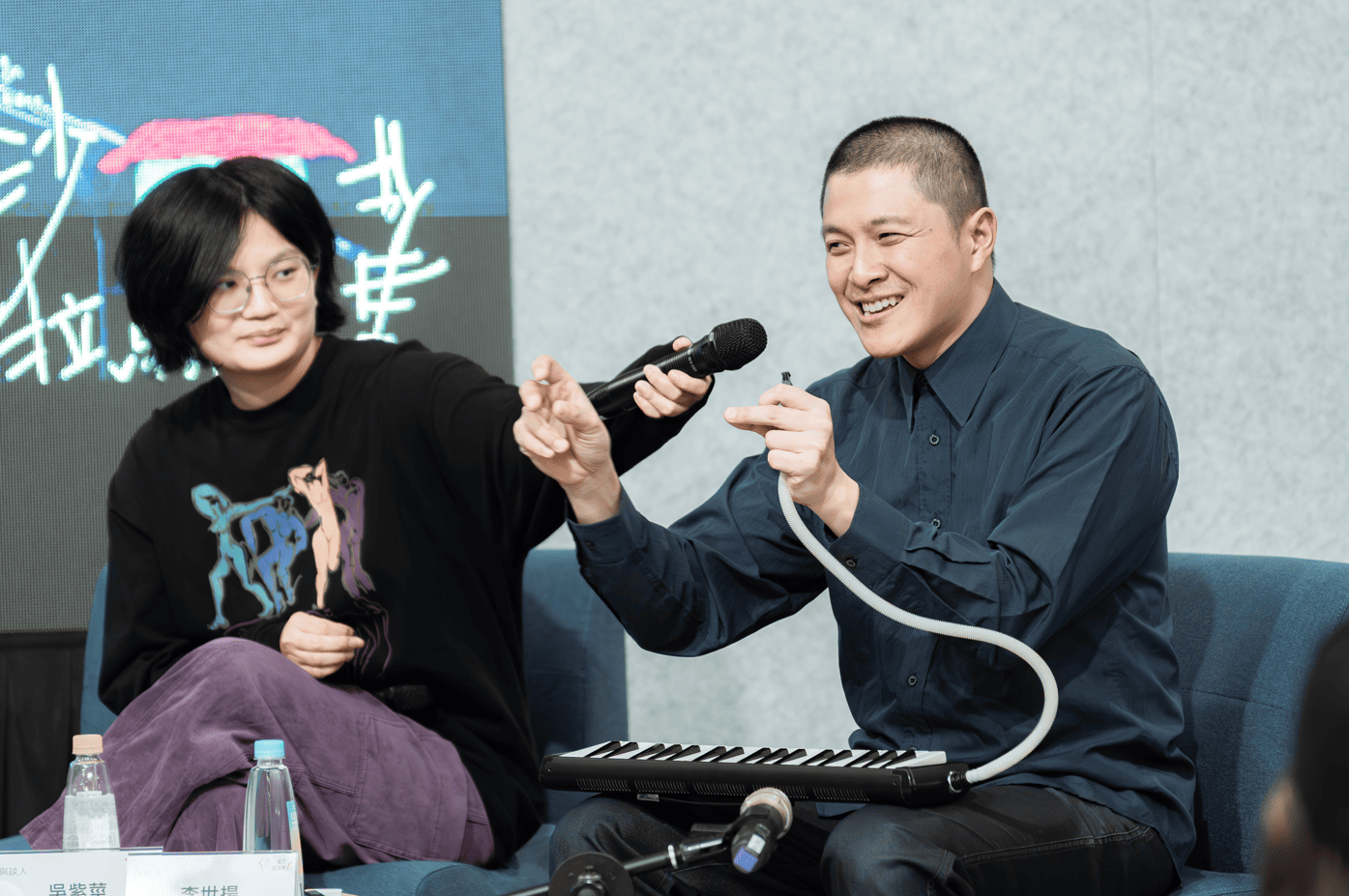
Winners of the inaugural Taipei Theatre Awards for Best Theatre Design—set designer Wu Tzu-ching and sound designer Lee Shih-yang—did not begin their sharing by discussing specific works. Instead, they first traced their respective paths into theatre.
Lee Shih-yang described how he had studied within the formal music-school system from elementary school onward, undergoing years of training focused largely on how to perform other people’s compositions well. It was not until after completing graduate school and participating in a theatre production for the first time that he realized sound on stage was not merely material to be played back, but something that responds in real time to the presence of the performance. For him, this marked a profound turning point: sound was no longer about completing a piece, but about actively participating in the performance itself.
He also spoke of a formative experience from 2014, when he worked on Slow Swing, Roll by the Lin Wen-chung Dance Company at the Taipei Arts Festival. In this work—an integration of nanguan music and contemporary dance—the choreographer required the musicians not only to perform but also to warm up, rehearse, and even move across the stage together with the dancers. This collaboration made Lee acutely aware, for the first time, that he was no longer standing at the edge of the stage producing sound, but entering the performance structure with his body. This experience became a crucial starting point for his later understanding of “sound as a role.”
Stage design is not only for display, but for enabling relationships to occur
Wu Tzu-ching shared a very different trajectory. Trained in theatre design, she graduated just as the pandemic struck and theatres shut down. Temporarily stepping away from her creative path, she worked in a bookstore and became involved in social movements. During that period, she questioned whether she should leave theatre altogether. Yet when performances gradually resumed and she returned to the rehearsal room, she became more clearly aware than ever that “a group of people being able to work together in the same space on a single piece of work for a period of time” is, in itself, deeply precious. It was at that moment that she chose to return to stage design.
Reflecting on the role of design in creation, Wu described stage design as a kind of “plate”—not merely objects or images, but a structure that carries the relationships between characters, between people and objects, and between performers and audiences. The task of design, she explained, is to connect these invisible threads so that they can function within the performance. Design is not about “what I want to do,” but rather about “what I am responding to.” Lee added that theatre is a highly collaborative field: sound design is rarely about doing whatever one wants, but about negotiating among the needs of the work, the director, performers, space, and technical constraints, in order to find the precise point where sound can truly intervene.
Realistic stages are not replicas of life, but the result of extensive research and selection
Wu then used her award-winning work How Long Will the King Stay in Tokugawa as an example to explain her understanding of realism in stage design. Set in a Japanese family home, the stage initially appears entirely ordinary: a living room, a dining table, everyday household items, resembling a real residence. Yet she emphasized that the “reality” of a realistic stage does not lie in copying life directly, but in the result of careful research and deliberate choices.
During the early design phase, she began from the script, analyzing the period and the family’s socioeconomic conditions. She went so far as to repeatedly browse Japanese rental websites, comparing floor plans, sizes, and locations as if she were preparing to move in herself, simply to determine what kind of place the characters lived in. Even though audiences never see the entire house, these invisible settings shape the actors’ movements and lines of sight; bodily, they know where a window should be, how space influences action, and how orientation guides attention.
Throughout rehearsals, the set was continuously adjusted. The dining table, as the center of the home, raised questions about whether characters had fixed seats and how this affected emotional and power dynamics. The position and orientation of windows, in turn, influenced how lighting could articulate different times of day. Wu noted that although such realistic stages appear mundane, every detail is intentionally designed.
She also mentioned that many pieces of stage furniture were not newly built, but salvaged from dismantled sets of other productions or obtained through informal circulation within the theatre community. This practice began as a pragmatic response to budget limitations, but gradually evolved into her creative stance toward reuse: stage elements are not meant for one-time consumption, but can be reassembled and reactivated across different works.
Designing a stage is not only about being seen, but about being bodily experienced
Another creative trajectory emerged from Wu’s collaboration with Lin Hsin-yi on the baby theatre work The Vanishing Sunlight Technique. Designed for infants under eighteen months and their caregivers, the project did not begin with narrative, but with a sensory experience of light. Low-pressure sodium lamps produce monochromatic yellow light that causes colors to disappear, leaving only brightness and silhouette. From this visual condition, the creators extended their imagination toward the psychological state of postpartum caregivers: when attention is entirely focused on a newborn, the world can suddenly feel desaturated, almost grayscale.
Within this framework, stage design could no longer function solely as something to be viewed, but had to return to sensory and bodily experience. Wu noted that she attended rehearsals far more frequently than in typical productions, moving in and out of the rehearsal space to test materials alongside the director and performers—how surfaces are touched, felt, and perceived. Parents and babies were even invited to test runs, allowing the team to observe whether the design was truly “received,” or whether it elicited unexpected responses. Since audiences were often lying on the floor or being held, factors such as stage height, material safety, and floor texture became indispensable design considerations.
How “limitations” become points of departure for creation
Lee described his shift toward theatre sound design as a series of responses to “limitations.” Having worked primarily with the piano for many years, he became aware early on that the instrument not only represents a sonic choice, but also entails high costs and specific spatial requirements. In theatre production, sound design often must operate within limited resources, prompting the search for more flexible approaches. This reality led him to move beyond the role of performer and toward thinking about how sound could function structurally within a work.
In The Salad Murder Case, for example, Lee avoided pre-recorded sound effects or looping devices. Instead, he intervened directly in the performance as a live musician. Deliberately setting aside the piano, he used violin, melodica, and various everyday objects to create sound in real time, allowing sound to enter into dialogue with the cadence, rhythm, and emotional shifts of the actors’ Taiwanese speech. The jury noted that this approach sustained the work’s eerie and absurd atmosphere, becoming a key force in constructing its sense of suspense.
Lee further demonstrated his compositional method: starting from a simple, easily recognizable melodic motif, he stretches rhythms, alters intervals, and adjusts tempo so that the same sound recurs throughout different sections without feeling repetitive. He likened this approach to film scoring—where an entire work may revolve around only a few themes, yet through continuous transformation and recall, sound subtly permeates the audience’s perception. This logic stems from classical music training, but is transformed in the theatre into a highly immediate, embodied sound practice.
What appears natural on stage is the result of long processes of thought, testing, and choice
During the audience Q&A, one attendee asked whether Lee ever experienced moments of “going blank” due to nervousness during improvisation. Lee responded candidly that nervousness never truly disappears, but improvisation does not emerge from nothing; it is built upon long-term listening and accumulation. He shared that he regularly listens to world music, jazz, and contemporary music, cultivating sensitivity to sound through diverse cultural and sonic imaginaries. In this way, improvisation becomes not merely a technique, but an ability to respond to the present moment.
Toward the end of the lecture, the host briefly introduced the speakers’ practices beyond the lecture itself—such as platforms for designer exchange, design-focused sharing channels, and related events—inviting audiences to understand theatre not as something that exists only during performance, but as a continuously operating community and network of labor.
After thanking the audience, the lecture concluded to applause. The discussion did not attempt to define “design,” but repeatedly returned to concrete working experiences: how design responds to real-world conditions, how it collaborates with others, and how it finds possibility within limitation. Through this sharing, forms of design labor long hidden behind the scenes were brought back into view. When these processes are truly understood, audiences may come to realize that what appears natural or self-evident on stage is in fact the result of sustained thinking, testing, and choice—and that this is precisely the most easily overlooked, yet most crucial, aspect of theatre.