Opening hours
:::
2026/06/09
She Says, She Says: On Separate Roads
By Hung Fang Yi, music and cultural studies researcher
She comes to this crossroads every day.
In the morning, she walks alone. People hurry past her, and traffic rushes by. Her pace is quick—so quick that anyone watching may think she is moving forward with purpose, even cheerfulness. No one can see her anxiety, her uncertainty.
At night, she is still alone, standing on a different road. The surroundings are quiet and deserted, and inside she feels hollow. The streetlights glow faintly, the moonlight blurs the distance. No one is in sight. She looks around in a panic.
Where should I go? Which path should I take?
In 1947, Zhou Xuan, the highest-paid star in the Chinese popular music scene, sang a song called “On Separate Roads” in Shanghai. During that period of time, the world around her was undergoing dramatic upheaval. The economy had collapsed. World War II had ended, yet the civil war showed no sign of stopping. The turmoil seemed endless, and the air was thick with a lingering sense of fear and uncertainty.
In the end, whether the singer herself felt anxious or uneasy, whether she faced the future with uncertainty or carried a sense of sorrow in her heart, was not what mattered most. What truly mattered was what the countless people listening to her songs were thinking and feeling at that moment. Compared to Zhou Xuan, who had hidden away bars of gold, ordinary listeners had far less in their pockets. They could not simply flee to a place of safety whenever they wished. Besides, where could they go, and how would they get there?
Lyricist Li Jun-qing excelled at conveying layered meanings through deceptively simple language. Rather than writing about romance, he used scenery to express emotion, demonstrating a classic, understated style of lyric writing. Not a single word meaning “sorrow” appears in the song, yet the passersby, the traffic, the streetlights, and the moonlight—all familiar urban images—allow listeners to hear the melancholy of an entire city through its landscape.
Composer Yan Zhe-xi built the melody on the blues scale, grounding it in a Boogie-Woogie rhythm that evokes a sense of being constantly pushed forward: unable to stop, yet with nowhere to go. Compared to traditional Chinese tones, the inherently melancholic character of the blues scale more effectively captures the social unrest brought about by hyperinflation and economic stagnation beneath the glittering surface of metropolitan Shanghai.
But when, exactly, did things begin to go awry? Take popular music, for example. The genre first emerged a full twenty years before “Two Roads.” In 1927, Shanghai was a rising international financial center, drawing foreign businesses, refugees, and adventurers from around the world to its International Settlement and French Concession. It was in this “Paris of the East,” a city shaped by ambition and desire, that the first Chinese popular song, “Drizzle” (Maomao Yu), was born. Its composer was Li Jin-hui, the musician who would later help cultivate the career of Zhou Xuan. He entrusted this love song to his daughter, Li Ming-hui, who would become the first singing-and-dancing star to captivate the silver screen. In doing so, he opened a door that would never again be closed.
Li Minghui sang it in her distinctive high-pitched voice. The song became such a sensation that Pathé Records, then one of the world’s leading record companies, eagerly brought her back into the studio time and again, armed with generous contracts and the brassy sound of jazz orchestras. Audiences could not get enough of it. Yet while the public embraced the song, the Nationalist government condemned it as a piece of moral corruption. After the Ministry of Education banned it in 1929, the song remained under prohibition until 1988. Regimes changed and eras passed, but its name never disappeared from the censorship list.
That a love song could provoke such anxiety among those in power suggests that what it moved was far more than the ears of its listeners. “Drizzle” opened the door, and through it came an entire generation of popular singers. Among them, the brightest star was Zhou Xuan.
By the time she recorded “On Separate Roads,” Zhou Xuan was at the height of her career as both singer and actress. She had released more than a hundred songs, many of them enduring classics. Blessed with a beautiful voice, acute musical sensitivity, and an innovative command of microphone technique, she could create the illusion that she was singing directly to each listener—confiding in them, almost whispering in their ear. She moved effortlessly between styles. Waltzes, regional folk melodies, rumba rhythms, and compositions rooted in Chinese musical modes all found a place in her repertoire. From the sweetness of “The Wandering Songstress” to the worldly yet detached elegance of “Night Life in Shanghai,” Zhou Xuan almost single-handedly defined the sound of her era. It is precisely for this reason that her interpretation of “On Separate Roads” feels so striking.
Indeed, Zhou Xuan carried the song’s swinging rhythm with her luminous, delicate voice. Yet she seemed to hold back the emotional ease for which she was known. Her delivery is unusually restrained, and her diction is almost excessively refined. She articulates the long-short triplet patterns with remarkable precision, while the high notes are deliberately rendered in falsetto. Beautiful as the sound remains, it lacks the openness and effortless poise that had become the singer’s hallmark. Moreover, the tempo is strikingly slow. One cannot help but wonder whether she is moving forward with caution, singing as she walks, thinking as she sings. As if a single misstep might send her over the edge.
What is particularly striking is that the original recording has no coda. The moment the song ends, the music disappears with it. It is as if the hesitation and anxiety, the tangled thoughts, even the two roads of day and night—together with the streetlights, the moonlight, and the endless flow of traffic—were nothing more than passing impressions, leaving nothing behind.
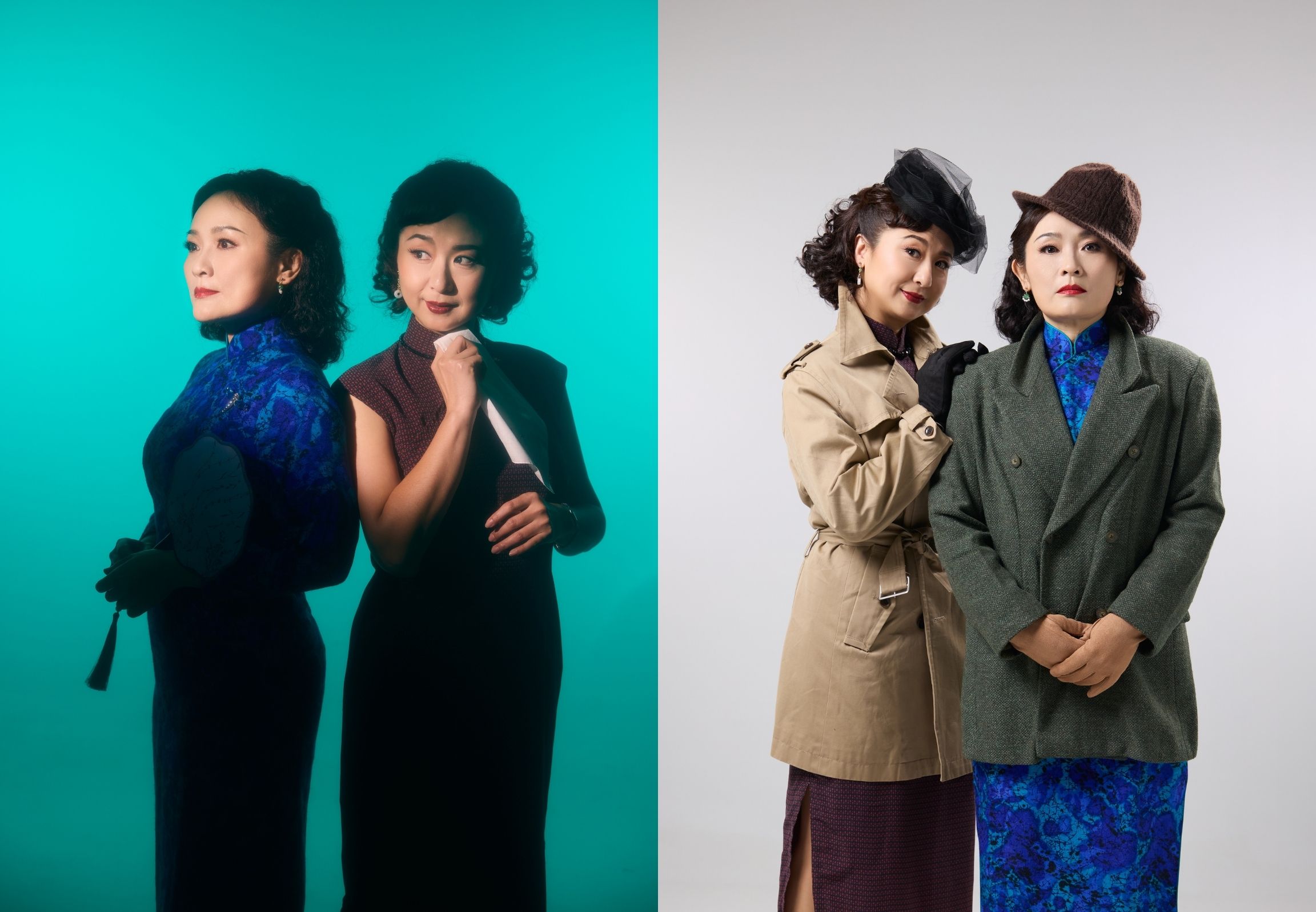 She Says, She Says. Photo by Chen,You-Wei.
With the voice as a form of performance, Zhou Xuan creates a character. Through her singing, she gives life to a figure standing at a crossroads, much like the countless listeners of her time. Caught between tradition and modernity, between staying and leaving, she longs to find a better place. It is from this crossroads that the two women of She Says, She Says set out. They leave Shanghai by way of an unnamed road. What they carry with them is not an answer, but a companion willing to walk beside each other. And the better place has never been waiting at the end of the road.
