Opening hours
:::
2026/06/17
Seasoning with Words, Simmering History for Reflection: Sensibility and Inquiry in Katherine Hui-ling Chou’s Dramatic Works
By Yu-Hui Fu (Assistant Professor, Department of Drama and Theatre, National Taiwan University)
Katherine Hui-ling Chou’s creative practice spans a wide range of subjects and approaches. Whenever she takes hold of a theme, she explores it with a depth and structural rigor that can rival a scholarly study. Her thinking is both profound and meticulous; the breadth of considerations can leave audiences and readers astonished by the connections she reveals.
In the late 1990s, after completing her master’s and doctoral studies at New York University, Chou worked as interpreter and assistant director to her mentor, Richard Schechner (1934–), one of the leading figures in performance studies. She also accompanied him to Taiwan to collaborate with Contemporary Legend Theatre on Oresteia (1995), a production of the Greek tragedy staged in Daan Forest Park. The project put Schechner’s concept of “environmental theatre” into practice, though this was only one aspect of his theatrical theories. It involved extensive intercultural and interdisciplinary negotiation, in which Chou participated firsthand. She understood that the central concern of environmental theatre lies in its engagement with the cultural and social environment surrounding the performance. Any production must therefore speak meaningfully to its local audience. In tracing the subtle threads of resonance and interaction between spectators and performance, one must also attend to the fluid use of space and the overall flow of the event.
She was not only an heir to the then-emerging field of Performance Studies, but also, through a trajectory entirely her own, came to be regarded as one of the leading scholars of gender studies in Taiwan’s theatre world. After returning to Taiwan from New York, she was invited to join “Min Sheng Theatre Reviews” (1996), published by Min Sheng Daily News. She later also became a core writer-director of Creative Society (1997), a theatre group known for its commitment to original Taiwanese scripts and its collaborative production model.
.jpg) Katherine Hui-ling Chou, writer and director of She Says, She Says (Photo courtesy of National Kaohsiung Center for the Arts – Weiwuying).
Katherine Hui-ling Chou, writer and director of She Says, She Says (Photo courtesy of National Kaohsiung Center for the Arts – Weiwuying).
Around 2000, her work I Love You, I Love You Not depicts four Taiwanese arts and cultural workers spending Christmas Eve together in New York. Through sharp, witty dialogue amid a festive gathering, the play satirizes conventional ideas of love and social roles. It teases the boundaries of love and desire across gender identities and sexual orientations through the characters’ actions onstage. In a mock wedding scene later in the play, the characters change costumes in full view of the audience to enact shifts of identity. The script’s provocative and irreverent tone vividly captures the anxieties of thirty-something BoBos—bourgeois bohemians—while serving as a metaphor for contemporary Taiwanese middle-class intellectuals immersed in a hybrid “Taipei–New York” cultural condition. In doing so, it confronts the uncomfortable realities of artists seeking refuge from the world around them. Chou once remarked that “gender is the oldest performance technique in human culture.” The sharp wit of her work does not arise from a deliberate staging of so-called “gender performativity.” Rather, it comes from first seeing through the illusion and then exposing it. Yet she never compels audiences to accept her conclusions. Instead, she lays out the terms of a dialectic and allows the outcome to confront the audience directly. Perhaps it is precisely because she approaches gender through the lens of Performance Studies that she is able to use plays, criticism, and analytical writings to let readers understand the fictional and fluid nature of identity during performance. One example is her review of Le Testament de Montmartre: Girlfriend Works No. 2, directed by Wei Ying-juan as part of Taiwan Literature Theatre series. Through writing, she articulated a mode of performance grounded in the authenticity of emotional language. In her subsequent theatre practice, Chou largely moved beyond realism’s reliance on the dramatic “if.” The emotional truths and narrative threads of her works instead reside within the theatrical atmosphere of performative representation, offering audiences what might be described as a “beyond-the-text” reading experience. For this reason, Chou’s writing is crafted with extraordinary care. At times, her words seem to prepare the emotional ground on which actors can build, creating a self-contained world that possesses its own reality, and even constructing a space for bodily expression and the circulation of energy. This quality is perhaps most evident in the performances of actors Hsu Yen-ling, Lin Zi-heng, and Hsu Hua-chien.
Katherine Hui-ling Chou is among the few playwright-directors capable of writing both Republican-era characters and diasporic narratives. Much of the critical discussion surrounding her work has focused on her ability to move between creative practice and theoretical discourse. Drawing on the character structure and temporal framework of Cloud Nine by British playwright Caryl Churchill (1938–), Chou reinterpreted “A Male Mencius’s Mother Teaches Her Son by Moving Three Times,” a story from Silent Operas by the late Ming–early Qing writer Li Yu. The result was the critically acclaimed original stage work He Is My Wife, He Is My Mother (2009, 2010, 2017, 2018), starring Hsu Yen-ling and Hsu Hua-chien. The production can be seen as a theatrical exploration of queer aesthetics and gender performance. Through a series of parallel contrasts, actors repeatedly cross and recross gender boundaries: women play men; male characters perform as women; male and female actors portray same-sex couples; and characters played across genders outwardly assume the appearance of heterosexual couples. Gender signifiers are thus layered, displaced, and thrown into productive confusion across the stage. This multiplicity of cross-dressing and gender crossing generates a form of irony that stands in contrast to the supposed openness of contemporary society. In doing so, the production successfully unsettles the heteronormative framework through which audiences have traditionally been taught to view theatre. Some critics have also praised Chou for transforming Li Yu’s critique of rigid moral binaries into a deeper inquiry by questioning what constitutes a family in a Taiwanese context. In the first half of the play, You Rui-lang, who castrates himself out of same-sex desire, later becomes the “Mencius’s Mother” figure celebrated by Confucian ethics. As a result, You Rui-niang—the maternal figure who sacrifices herself for the sake of family and social morality—becomes entangled in overlapping questions of gender, kinship, and domestic obligation, emerging as a profoundly irresolvable contradiction.
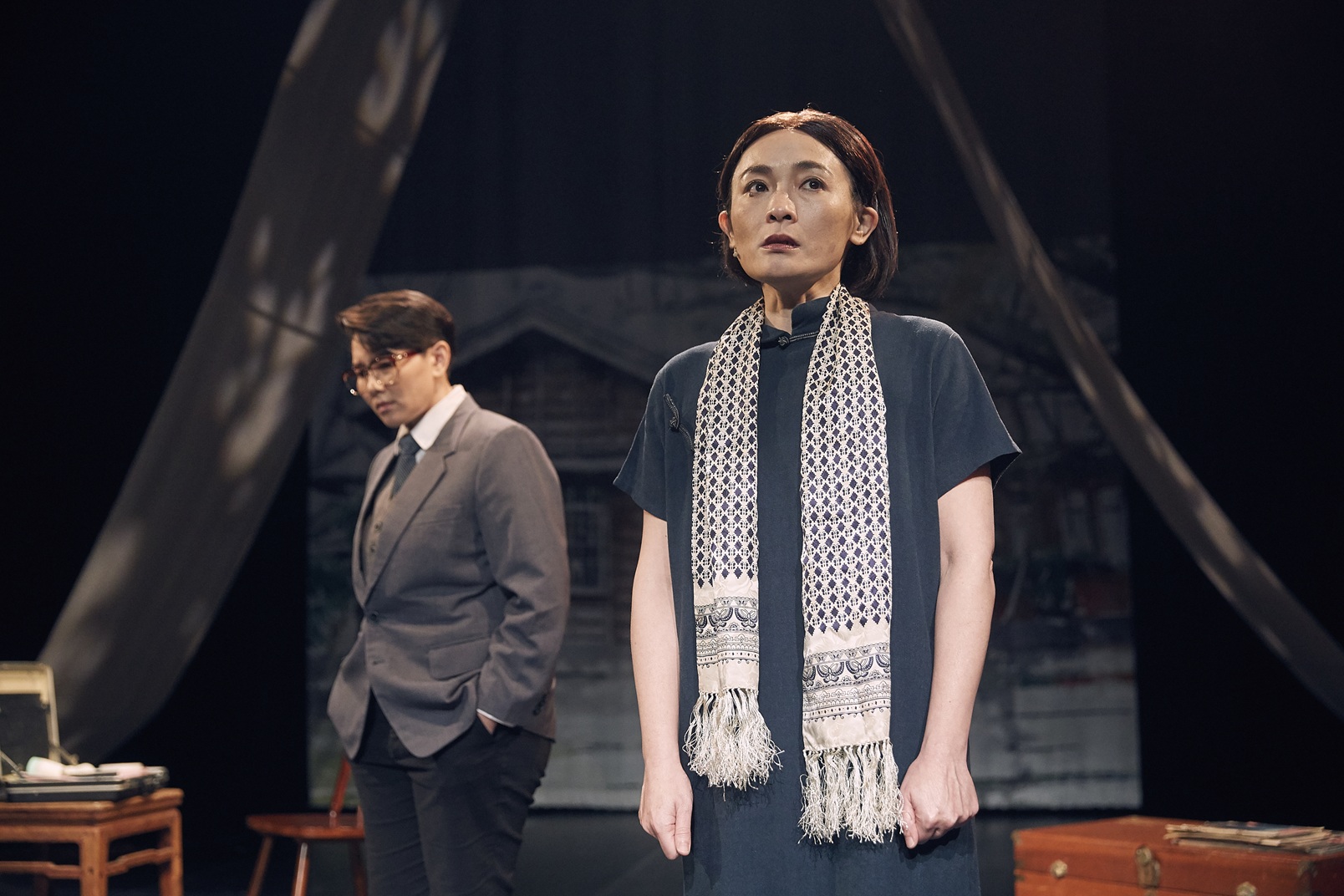 He Is My Wife, He Is My Mother (Photo courtesy of Creative Society).
Chou’s latest production, She Says, She Says (2026), appears to bring together concerns that have run through several of her earlier works, including Memory Album (2002), to be AND not to be (2006–2007), and Have Wok, Will Travel (2009–2010), all of which explore Taiwan’s collective condition. In Memory Album, through the family history of a woman living with depression, Chou constructs a theatrical structure of memory that remains “perpetually open to revision,” forcing audiences to confront historical truths and traumas that can never be fully disentangled. From a more intimate female perspective, to be AND not to be unfolds through conversations between two women—one living, the other a spirit—in the liminal realm of the bardo. Through their encounters, the work explores the awkward state of being neither fully alive nor fully dead, extending this condition from the personal to the national. Have Wok, Will Travel, meanwhile, employs a contrapuntal relationship between theatre and dance to weave together past and present. The work evokes the romantic yet bittersweet experiences of Taiwan’s first generation of female soldiers in the 1950s, bringing attention to a group largely absent from modern Taiwanese history while simultaneously questioning the place of women within dominant historical narratives. Most importantly, Chou’s work as a playwright and director is distinguished by its intellectual rigor and rich historical and literary intertextuality. Drawing on classical texts, local legends, and the lives of ordinary individuals, she invites audiences into an ongoing dialogue about gender, history, and trauma, encouraging them to scrutinize the authenticity of the historical contexts they inhabit.
