Opening hours
:::
2026/06/02
TPAC Academy 2026 Spring Dramaturgy and Theater Creation Courses: Moving Forward to Welcome a Better Theater World
Scriptwriting was the focus of TPAC Academy’s 2026 Spring Dramaturgy and Theater Creation Courses. These courses explored multiple facets of theater creation, providing one note after another for theater creators, critics, and audiences, from the secrets behind the history of the black box to setbacks experienced by creators, co-creation experiences, and the complexity of layers formed from the intertwining of the stage and life.
These courses were not just designed to teach techniques. From awareness of history to narrative flow and negotiations during co-creation, they culminated in a reflection of the magnificent image of contemporary theater, providing each theater follower with something they could use, ponder, and bring to fruition.
Confronting the “modern” theater world: The difficulties and freedom of contemporary creators and audiences
The starting point for the theater is how we “view” it. Wang Chun-Yen, who earned a PhD in theater studies from Cornell University, led participants in confronting the “black box theater,” a remnant of realism, to break through the linear thinking of Eurocentrism. He also pointed out that “modernism” is itself translingual translation and negotiation.
At the very beginning, Wang reminded the participants that the term “modern drama” is highly problematic and is by no means a universal aesthetic. Instead, it refers to theater aesthetics and actions specific to Europe at the end of the 19th century. Later, it became the “sole standard” that the whole world was forced to accept.
If in the context of early 20th century Asia (such as that of China and Taiwan), we discover that it was due to widespread anxiety that intellectuals of that time embraced European realism. It seemed that only playwrights like Henrik Ibsen paid serious attention to and addressed social problems and, as such, were considered progressive.
Ibsen’s works, written in the 1880s, are considered classics of modern drama. They undoubtedly foreshadowed the shared human condition of 150 years ago to the present day. This condition can be summarized in two words: individual (who we imagine ourselves to be) and freedom (according to the boundaries we want to set). Both deserve further reflection. Ibsen did so but we failed to see it.
Wang also mentioned that just as people came to believe that realism represented the aesthetic paradigm of “Western uniformity,” historical events slapped them hard in the face. “In the 1890s, Hedda Gabler was performed all around Europe. Internally, Europe was in chaos, with much finger pointing taking place. There was no harmonious or uniform ‘Western perspective.’”
When Hedda Gabler, which tells the story of a woman, a control freak who ultimately took her own life with a gun, was viewed by audiences in different countries, reviews varied drastically. In Norway (Northern Europe), the view was that it highlighted the struggles of women under the social structure. People there were concerned about the social structure and environmental casualties. Norwegian critics pointed out that Hedda was an oppressed individual and her madness and resistance, under institutions such as Nordic Lutheranism and the state, offered an escape from the constraints of the status of women and society. They saw in Hedda opportunities for “the individual” and “freedom.”
In the minds of the British, the Ibsen they once admired suddenly became unfamiliar to them. Critics expressed their frustration with and complete lack of comprehension of this work. British audiences of that time were used to melodramas in which there were clearly distinguishable characters “who cried when they should and hated when they should.” However, Hedda was an ambiguous character, whose thinking and actions were enigmatic, and British audiences found this work morbid and difficult to digest.
Ibsen once said that “Hedda Gabler is not about dealing with so-called social issues. What I yearn to depict are the human condition, human emotions, and human fates.” In Ibsen’s mind, Hedda was not a madwoman. She more closely resembled the “archetype” of the modern person.
For Wang, this archetype of modernity, individualism, and freedom is fraught with problems and far from standard. It is also unable to point to the future. He believes that what is best and most troublesome about the emergence of modern drama is that “there is no longer a single correct interpretation in the theater.” No one individual or aesthetic genius can monopolize the representation of a script. In the past, people were too accustomed to seeing the shift from realism to postmodernism as linear and uniform aesthetic progression. It was if the West had a stable aesthetic god who was guiding the development of human theater. But if we pull back the curtain of history, we see the tearing apart, misunderstanding, and necessary production processes as Norway and the UK were presented with the same script. It then becomes clear that the West and Europe never had a monolithic system.
In Taiwan, and in contemporary theater, when we create an all-new production of Hedda Gabler, what kind of existential situation does that correspond to? At that time, the questions they raised relating to “individual” and “freedom” seemed to have been wholeheartedly accepted in Taiwan, which inherited solutions originally tailor made for Europe, but avoided the limitations and blind spots of translation. Wang also noted, “If these have been resolved, then what kind of understanding of modern theater do we need to foster? If these have not yet been resolved, how can we, through cultural translation, renew the promotion of theater in its reidentified and dialectical historical position?” He anticipates more dialogue and exchanges on this topic.
.jpg) (Photo by Chen-Chou Chang)
(Photo by Chen-Chou Chang)
Continuously flowing boundaries: Narratives don’t stop, they only come closer to one another
For this course, Koh Choon-Eiow, co-artistic director of approaching theatre, drew on his experience of growing up in another country. He explored how creators transform literary narratives, such as personal memories and ethnic experiences, into stage actions across three roles: playwright, director, and actor, placing the self and the other at the boundary between reality and fiction.
To begin his lecture, Koh quoted a well-known line from literary master Lu Xun’s “Autumn Night,” “From my backyard, I can see two trees beyond the wall. One is a jujube tree. The other is also a jujube tree.” This classic literary narrative, which is somewhat redundant and even “nonsensical,” would instantly lose its literary tension if rewritten to fit the concise clear logic of modern language: “From my backyard, I can see two jujube trees beyond the wall.”
Koh pointed out that while this rewrite clearly states the facts, it loses the “flavor” and sense of space for observation of the original. Lu’s line, through deliberate pauses and repetition, creates a sense of distance and an order of observation for the reader. This breaking of linguistic convention and creation of distance is called defamiliarization in literary theory.
The challenge of theater lies precisely in how to unravel the textual meaning that has been solidified by space, body, and structure and revive it on stage as a fluid, multifaceted, living entity. Koh likened a creator to a “window” or “medium.” The work of creators is not to present their subjective emotions to the audience but to diligently hone their sensibilities and integrate personal life experiences, issues that they are passionate about, and extensive reading and research into a vast internal database. When writing begins, the creator retreats into the background, allowing the audience to gaze through this window onto broader, more complex, and more heterogenous social and historical landscapes.
During this course, Koh meticulously analyzed three of approaching theatre’s representative works: Chronology on Death (2011), Outsider (2017), and Ghostopia (2024). In terms of the script structure for Chronology on Death, Koh boldly abandoned conventions, such as cause-and-effect plot development favored by Ibsen and Shakespeare. He also refused to present this work in a plain, straightforward, undramatic, and unattractive documentary style. At that time, in Taiwan there was a rise in popularity of the “New Writing” movement introduced from Europe. In this style, the script is filled with long monologues and breaks free from the conventional punctuation and character notations. It even exhibits strong speculative and deconstructed elements, which deeply inspired him.
He also highlighted the greatest challenge in developing Outsider, the open on-stage display of “cultural hierarchy,” which is universal but not easy to talk about. To tear away the mask of hypocrisy of middle-class warmth, Koh through an outsider, “the uncle,” included “folksy” but extremely politically incorrect jokes. The mix of historical bias and humorous banter on the stereotypes of Chinese, Malays, and Indians in Malaysia, which came close the point of vulgarity, caused people to feel awkward and uncomfortable, thoroughly shattering the carefully maintained transnational middle-class elegance of the other three characters in the play. This linguistic offensiveness and violence precisely pinpointed the lingering historical trauma and class anxiety hidden within the semblances of transnational marriage and immigration.
In terms of script composition, Ghostopia fully embodied Koh’s masterful manipulation of genre elements, taking advantage of the audience’s familiarity with and psychological expectations of the popular horror film genre, which served as tools for defamiliarization. Audiences entered the theater or online space with their defenses up, as if prepared to watch a horror film, but were instead confronted with profound reflections on capitalism in Taipei’s urban spaces, the emotional isolation of modern people, and the erasure of the lower classes. This work precisely translated the genre elements of commercial entertainment into a powerful blow to contemporary urban civilization (the antithesis of utopia – Ghostopia).
Koh concluded by citing a core idea in Korean scholar Shin Young-Bok’s Discourse (on Social Undertakings): Last Lecture Notes: “How something is said” is often more important than “what is said.” This is because even completely identical words can convey different meanings depending on the tone, structure, and context in which they were spoken.
.jpg) (Photo by Chen-Chou Chang)
(Photo by Chen-Chou Chang)
From individual to co-creation
Creating a script can be a process of push and pull or companionship. The collaboration between Chiu An-Chen and Li Lu showcased two paths to scriptwriting. One is solitary, such as the three-year field survey for Father Mother and bringing The Mandarin Class to life as its playwright. The other is cross-generational co-creation, such as two playwrights of two different generations inspiring and supporting one another as they collaborated on the script for Cinderfella.
In 2017, after performing in White Storyteller, Chiu realized that there was so much he did not understand about the land beneath his feet. To uncover its hidden past, he enrolled in a class on the period in Taiwan’s history known as “the White Terror,” taught by Lin Chuan-Kai at Xinyi Community College. He listened to the descriptions of political suffering, as they overlapped with the contemporary landscapes of Xinyi District, Liugui, and Ximending.
From this effort to revisit the past came Cinderfella. The story of Tsai Chih-Yuan, a victim from that era, inspired Father Mother and that of “Feng Feng” also strongly resonated with Chiu. Feng Feng (1935-2007) was a unique figure in 1950s Taiwan. He was a translator and novelist, who was obsessed with the experiences of those who had come from China to Taiwan and the Taiwan-Japan conflict. However, he never talked about his homosexuality or political trauma. In 1997, his resentment over his failed attempts to receive compensation for his suffering during the White Terror, due to the loss of documents needed to verify his claim, led him to pour all his memories, hallucinations, and experiences of ethnic violence into Voyage in the Mist, a million-word autobiographical novel in which truth is difficult to distinguish from fiction.
For Chiu, who has long been concerned with LGBT issues, Feng Feng’s story was of special political significance because of what had happened to him during the White Terror and symbolized the “gender/LGBT” marginalized groups. However, to reach a wider group of victims and cross the moral boundary between “reality and fiction,” Chiu and Li, after millions of words of background reading, chose to pick apart and reshape Feng Feng, creating a character that blended reality and fiction.
The script for Cinderfella was developed over a period of eight months. Once a week, Li would head to the theater company and work intensely with Chiu from 1:00 to 5:00 in the afternoon. They developed a “crazy mutual revision model.” After allocating the writing of scenes between them, they handed what they had written to the other person who carried out meticulous revision.
Both parties were fully committed to this collaboration. Some of their most unforgettable memories were of Chiu sending his revised work and pushing Li to look it over and make changes on Lunar New Year’s Eve and Lunar New Year’s Day, during which she was busy washing dishes in the kitchen. He was so fast that Li was almost pushed to her limit.
What truly underpins the script’s depth is the solid fieldwork. For example, they interviewed Peng Jen-Yu, an Academia Sinica consultant who studies trauma and physiological mechanisms, and listened to the oral histories of White Terror victims.
During their fieldwork, they discovered a cruel and sad reality. Most of the victims who had experienced inhumane treatment while incarcerated were unwilling or “unable” to talk about it. The political violence they experienced had been internalized as sensory memories and manifested as post-traumatic stress disorder (PTSD), which significantly affected their lives. For example, after their release, they went to extremes to conserve water. At night, they repeatedly checked doors and windows to make sure they were locked. They also remained on alert for signs of wiretapping. These precisely internalized and unspeakable details of their trauma were represented in the behaviors of the character.
As the script was fleshed out, a dialectical relationship emerged between two storylines, one “historical” and one “contemporary.” A modern subplot was the key to preventing the script based on a period in history 80 years ago from becoming didactic or dry. After much deliberation, Li proposed incorporating elements of the Sunflower Movement and policing into this modern subplot. Following its premiere at the Experimental Theater, Cinderfella garnered extremely positive reviews for its historical depth and the powerful energy and tension that were created during this one-man show. For subsequent performances, the theater company made the bold decision to cast comedian Kurt Hsiao as the lead in an attempt to inject some lightheartedness and laughter into this otherwise serious work on Taiwanese history.
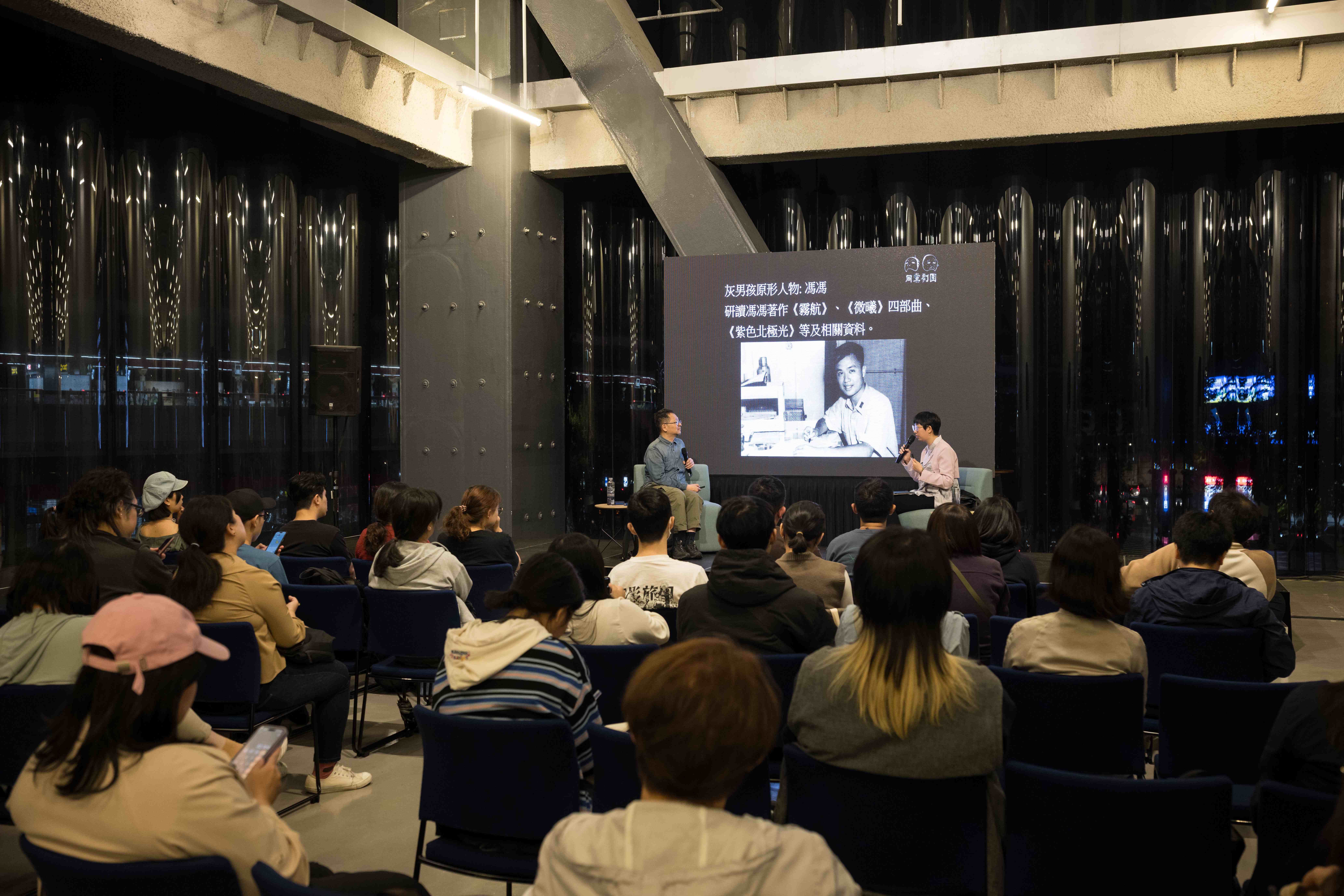 (Photo by Chen-Chou Chang)
Ambiguity and clarity: The reciprocal dialogue between lighting and drama
Director Wang Shih-Wei chose to focus on Jon Fosse’s play I Am the Wind for this course, introducing the “sublime” aesthetics of 19th century landscape paintings to contemporary lighting control and the use of light and shadow to capture the loneliness and unease in the face of the vastness of life.
During the lecture entitled “Light Beyond the Canvas: Between the Sublime and Solitude,” Wang and lighting designer Kao I-Hua began a fundamental exploration of “darkness” and “the function of lighting” in the theater. For them, lighting is not the mere “illumination” of actors. It is “a fluid existence,” shaping the space, guiding the dramatic process, and even awakening the audience’s senses.
In essence, for contemporary lighting design to be outstanding, it must “follow the dramatic process (the play),” rather than simply serve as a functional shift. Lighting helps to lay the groundwork for, as well as build up and advance the play. For example, in La Réunification des deux Corées, the stage is composed of images and projections, which completely differs from conventional lighting that only functions to illuminate the sets and the actors. Against a dark background, skillful lighting design can provide the details to smoothly guide the audience into the temporal and spatial setting of the play.
Wang and Kao also listed international figures who have profoundly influenced modern theater visual effects and lighting aesthetics. Based on these case studies, they analyzed how “light” can be viewed as a type of material and how directors and designers can engage in cross-disciplinary dialogue.
They began by examining Robert Wilson’s visual aesthetics. No matter if directing a fairy tale, modern opera, or Greek tragedy, his visuals are highly recognizable, from long horizontal lighting zones in which light diffuses and spreads across the entire two-dimensional space to the skillful use of silhouettes that enable the actors to completely blend in and become part of the set and precise local lighting and spotlights that illuminate only the actors’ heads or certain parts of their bodies.
This type of extremely precise lighting control allows the audience’s senses and line of sight to be focused on an extremely small point rather than on the stage as a whole, imbuing the theater-going experience with a strong sense of ritual, like flipping through the pages of a fairy tale or a photo album.
Kao also shared her thoughts on South African artist William Kentridge’s theatrical work Sibyl. What impressed her most about this work was the rebellious use of “images (projections) as light sources.” During the performance of Sibyl, Kentridge placed a projector at the proscenium opening (the edge of the stage) such that it projected forward. The stage was filled with his signature stop-motion animated images and text, while the live performers and dancers on the stage stood directly in the path of the projected beams. This is taboo in conventional theater productions. However, Kentridge turned attempts to avoid this conventional theater shortcoming into something highly poetic.
Wang next introduced Italian director Romeo Castellucci, someone he admires very much. Castellucci emphasizes visual impact but is opposed to the idea of using visuals merely to create a stage “spectacle.” One of Castellucci’s most iconic techniques is the hanging of a “holographic curtain” made up of one or more extremely thin layers. He uses this holographic curtain to blur and obstruct the audience’s line of sight, while initiating intricate shifts in lighting behind it.
Wang noted that the more the action on stage is blurred and obstructed, the harder the audience members try to focus on the textures of the objects or scene. This kind of visual struggle and desire makes them feel in their soul as if their skin is in direct skin contact with the shapes and textures on the stage.
The core discussion revolved around this concept of “the sublime.” Wang pointed out that this is a concept that has fascinated him both in his theatrical creative work and life in recent years. He believes that no matter how the definition of the sublime has evolved, the reason why this concept captivates people is that it points to the vast beauty of the external world and the profound and enormous sense of loneliness that is associated with perceiving ourselves as small and insignificant.
During the latter half of the course, these two artists attempted to connect the abstract concepts of “the sublime and solitude” to their current theatrical creative practices. This led them to jointly conceptualize a performance of I Am the Wind by Fosse, a Norwegian playwright and Nobel Laureate.
Wang used self-deprecating humor to describe this discussion as a “lighting design meeting.” As they followed the descriptions in the script, they came to the line, “Gray reefs, bare and barren…behind them the sea…the sea was calm…” Faced with this minimalist yet vivid text, they each chose a well-known painting from art history for visual inspiration.
Finally, they shared their consensus on their vision for I Am the Wind: “a very dark performance.” However, this darkness is not about deliberately arousing fear or creating a cheap sense of sadness or a gloomy atmosphere. “It is about using black and the unknown darkness to reawaken the audience’s numbed senses and perceptions in the theater.” When the audience is left to grope about in the dark, unable to clearly see anything, their hearing, their skin, and their alternative way of viewing (contact with the mind and spirit) are truly awakened amidst the solitude and the sublime.
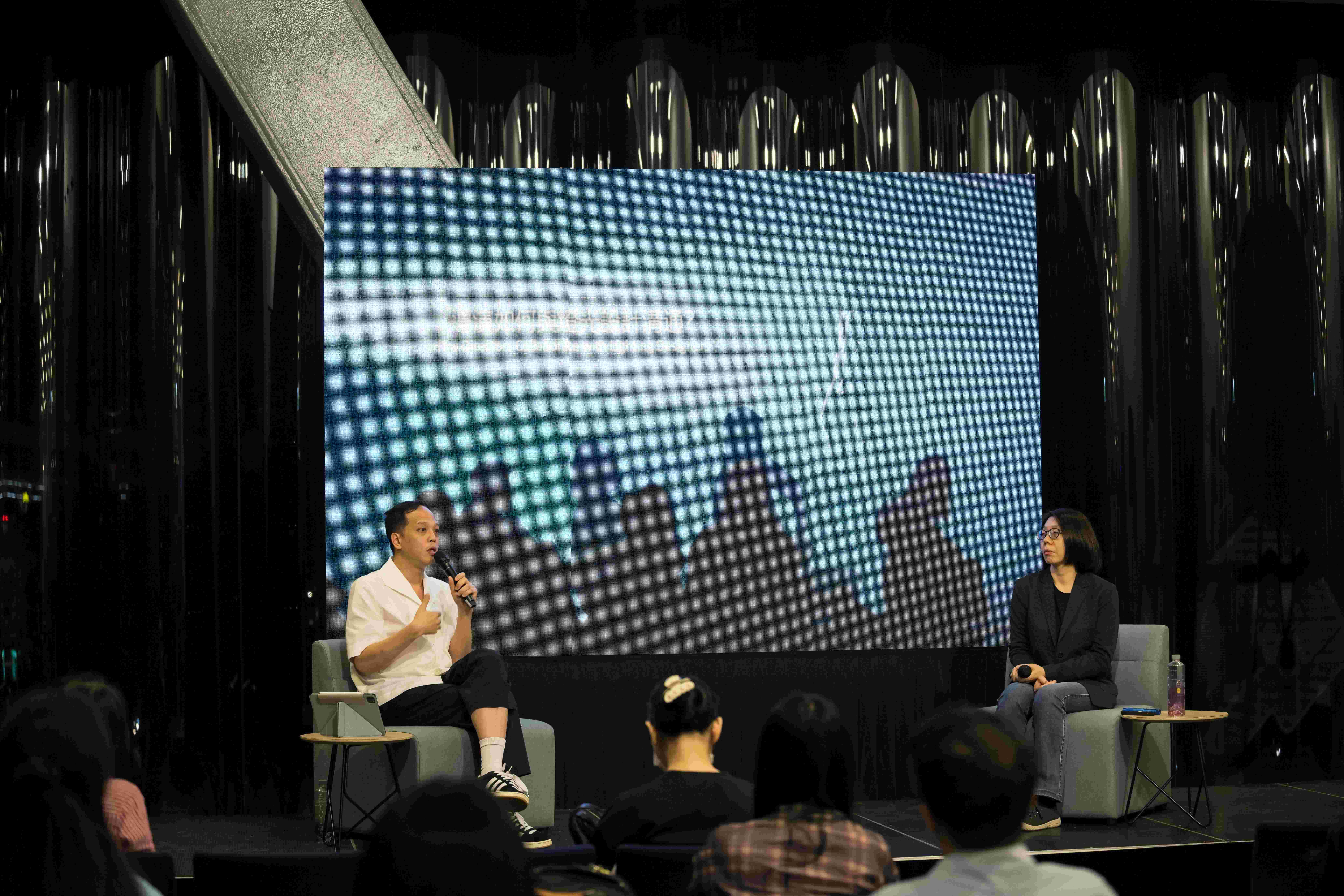 (Photo by Chen-Chou Chang)
